The FCLE may show a political cartoon and ask what it refers to or which constitutional idea it illustrates. Here are 10 famous cartoons, from 1754 to 1915, with what each one shows, the event behind it, and the constitutional concept it connects to.
How to read a political cartoon
Read every label and caption. Cartoonists name the people, states, and groups they draw.
Find the date. The date tells you which event or debate it is about.
Look for symbols: Uncle Sam or Columbia (the nation), a crown (a king or abuse of power), a snake or octopus (danger or greed), pillars (strength or union).
Notice exaggeration. Who is drawn huge, small, proud, or weeping tells you the cartoonist's opinion.
Connect it to the Constitution. Ask which power, right, amendment, or principle is at stake.
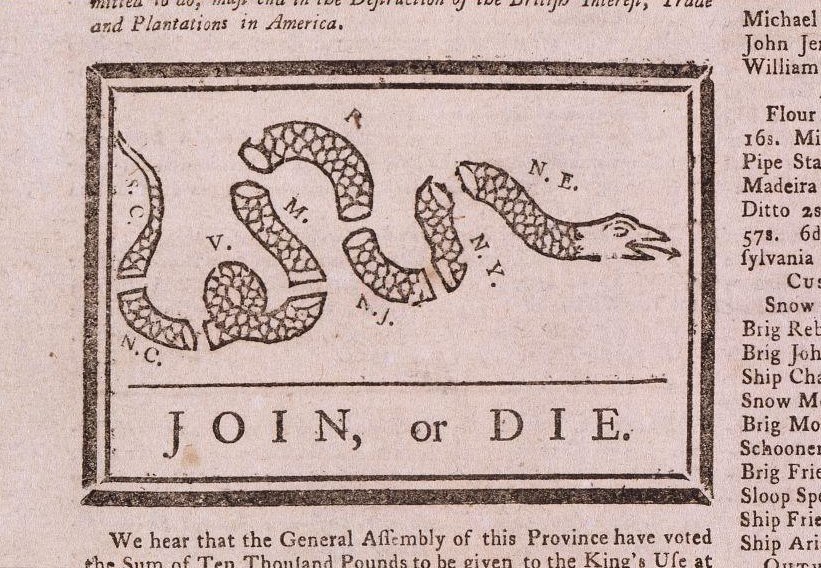
Benjamin Franklin, The Pennsylvania Gazette, May 9, 1754. Library of Congress, Prints and Photographs Division (no known restrictions on publication).
What it shows: A snake cut into eight pieces, each labeled for a colony or region: New England, New York, New Jersey, Pennsylvania, Maryland, Virginia, North Carolina, and South Carolina.
What it references: Franklin drew it at the start of the French and Indian War to support the Albany Plan of Union (1754), his proposal for the colonies to unite for defense. A folk belief held that a cut snake could come back to life if its pieces were joined before sunset. Patriots reused the image during the Revolution.
Constitutional concept: Unity among the colonies, an early step toward a union of states and, later, federalism. The colonies rejected the Albany Plan, but the idea returned in the Articles of Confederation and the Constitution. (Principle: Federalism)
Think about it: Why would Franklin draw the colonies as pieces of one animal rather than as separate creatures?
Show an answer
He was arguing that the colonies would survive only if they united; apart, each was too weak to defend itself.
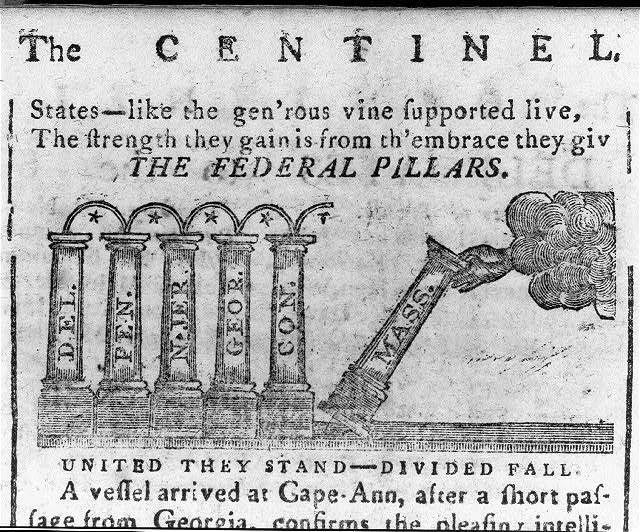
Unknown artist, The Massachusetts Centinel (Boston), January 16, 1788. Library of Congress, Prints and Photographs Division (no known restrictions on publication).
What it shows: Five pillars labeled for the first five states to ratify the Constitution (Delaware, Pennsylvania, New Jersey, Georgia, Connecticut), joined by arches. A hand from the clouds raises a sixth pillar, Massachusetts. Caption: "UNITED THEY STAND—DIVIDED FALL."
What it references: The fight to ratify the Constitution in 1787-1788. The Boston newspaper ran it while the Massachusetts ratifying convention was still debating; the hand raising the sixth pillar expresses the hope that Massachusetts would join. It did, ratifying on February 6, 1788, by a close vote (187 to 168) and with recommended amendments. The Centinel ran updated versions as more states ratified.
Constitutional concept: Article VII: the Constitution would take effect when nine of the thirteen states ratified it. New Hampshire became the ninth in June 1788. Massachusetts's recommended amendments helped lead to the Bill of Rights. (Principle: Popular sovereignty)
Think about it: How many more pillars did the cartoonist need before the Constitution could take effect?
Show an answer
Three more after Massachusetts: Article VII required nine states. Maryland, South Carolina, and New Hampshire (the ninth) followed.
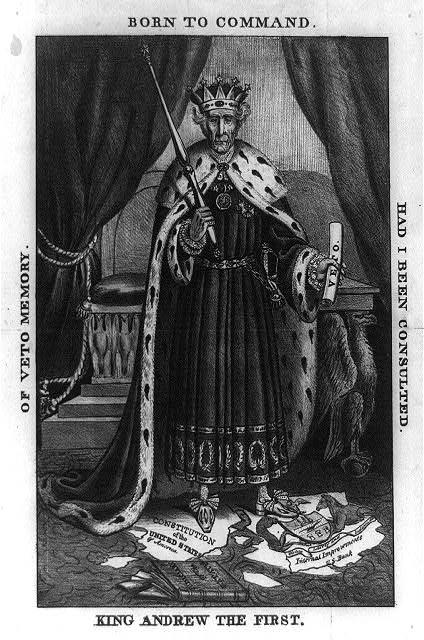
Unknown artist, Lithograph, 1833 (publisher unknown). Library of Congress, Prints and Photographs Division (no known restrictions on publication).
What it shows: President Andrew Jackson in a crown and royal robe, holding a scepter and a scroll labeled "VETO," standing on a torn copy of the Constitution and on papers about internal improvements and the U.S. Bank. Side captions: "Of Veto Memory" and "Had I Been Consulted."
What it references: Jackson's veto of the bill to recharter the Second Bank of the United States (1832) and his frequent use of the veto. His opponents, who formed the Whig Party, said he acted like a monarch.
Constitutional concept: The presidential veto (Article I, Section 7) is a legal check on Congress, but critics argued Jackson was abusing executive power and ignoring the Constitution. The cartoon raises the question of checks and balances and limits on the executive. (Principle: Checks and balances)
Think about it: Why would the cartoonist show Jackson standing on the Constitution?
Show an answer
To argue that Jackson was trampling the Constitution's limits on executive power, acting like a king rather than an elected President.
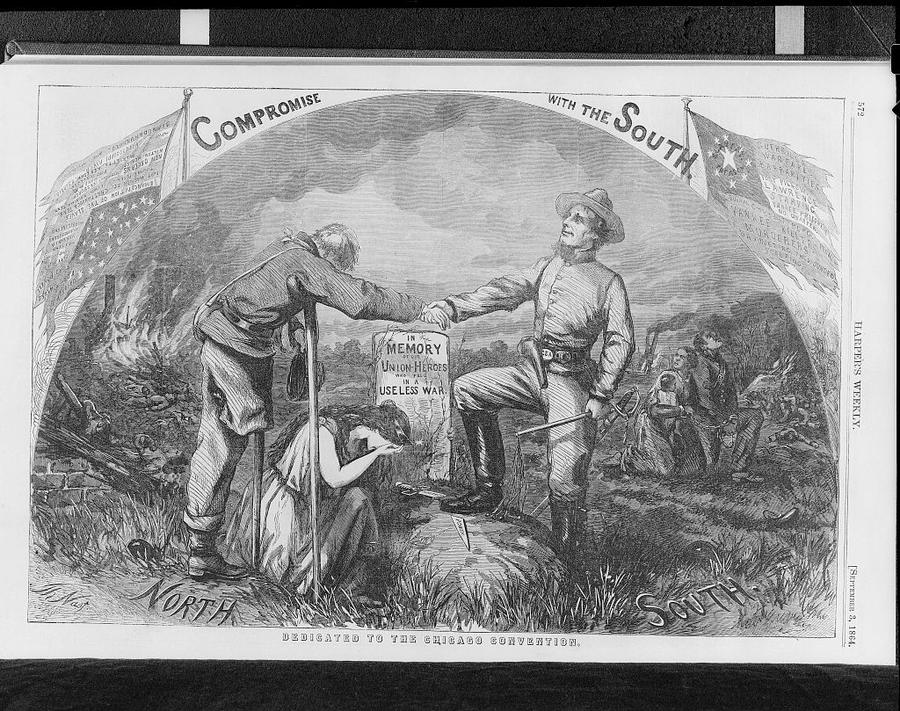
Thomas Nast, Harper's Weekly, September 3, 1864. Library of Congress, Prints and Photographs Division (no known restrictions on publication).
What it shows: A confident Confederate soldier, his foot on a grave, shakes hands with a wounded Union soldier on a crutch, while Columbia (a symbol of the nation) weeps. The grave reads "In memory of Union heroes who fell in a useless war." The caption dedicates it to "the Chicago Convention."
What it references: The 1864 presidential election. The Democratic convention in Chicago adopted a platform calling the war a failure and seeking peace talks. Nast argued that such a "compromise" would surrender everything the Union had fought for. Lincoln won reelection.
Constitutional concept: The Union is permanent and secession is illegal (Lincoln's First Inaugural); and Union victory led to the 13th Amendment (1865) abolishing slavery. (Principle: Federalism)
Think about it: What did Nast think would happen to the sacrifice of Union soldiers if the North compromised?
Show an answer
It would be wasted: the South would win on its terms, slavery would survive, and the dead would have fallen in a "useless war."
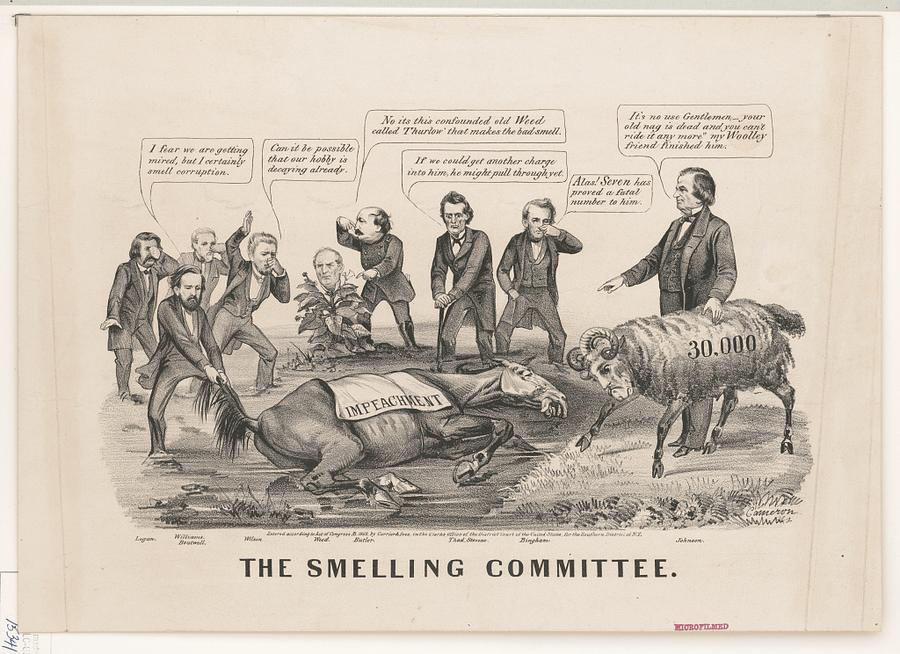
John Cameron, published by Currier & Ives, Currier & Ives lithograph, 1868. Library of Congress, Prints and Photographs Division (no known restrictions on publication).
What it shows: Radical Republican leaders (including Thaddeus Stevens and Benjamin Butler) hold their noses around a dead horse labeled "IMPEACHMENT." President Andrew Johnson stands at right and says their old nag is dead. One says, "Alas! Seven has proved a fatal number to him."
What it references: The 1868 impeachment of President Andrew Johnson. The House impeached him, mainly for firing Secretary of War Edwin Stanton in defiance of the Tenure of Office Act. The Senate fell one vote short of the two-thirds needed to convict, because seven Republican senators voted to acquit.
Constitutional concept:Impeachment as a check on the executive: the House impeaches by majority vote; the Senate tries the case, and conviction requires two-thirds of senators present. (Principle: Checks and balances)
Think about it: What does "seven has proved a fatal number" refer to?
Show an answer
The seven Republican senators who voted with Democrats to acquit Johnson, leaving the prosecution one vote short of two-thirds.
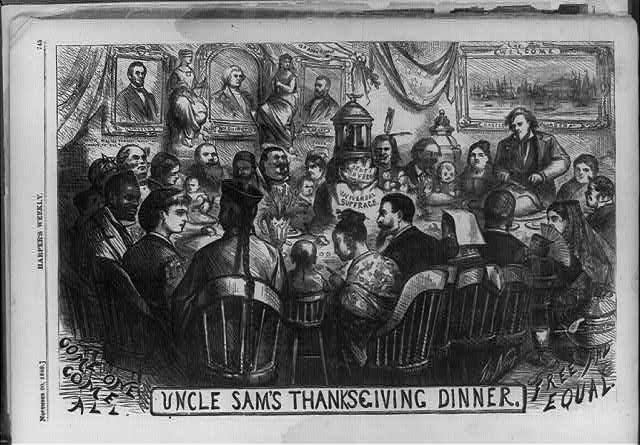
Thomas Nast, Harper's Weekly, November 20, 1869. Library of Congress, Prints and Photographs Division (no known restrictions on publication).
What it shows: Uncle Sam carves the turkey at a table shared by Americans of many backgrounds: Black, white, Chinese, Native American, Irish, and others, women and children included. The centerpiece reads "Universal Suffrage"; the corners read "Come one come all" and "Free and equal."
What it references: Reconstruction and the push to ratify the 15th Amendment, which Congress had passed in February 1869 and the states ratified in 1870.
Constitutional concept: Equality and voting rights: the 15th Amendment bars denying the vote because of "race, color, or previous condition of servitude." Equal protection (14th Amendment) and the ideal of "all men are created equal." (Principle: Individual rights)
Think about it: Which constitutional change was Nast celebrating, and who was still left out of it?
Show an answer
The 15th Amendment's ban on racial discrimination in voting. It did not give women the vote (that came with the 19th Amendment in 1920), and Chinese immigrants could not become citizens until 1943.
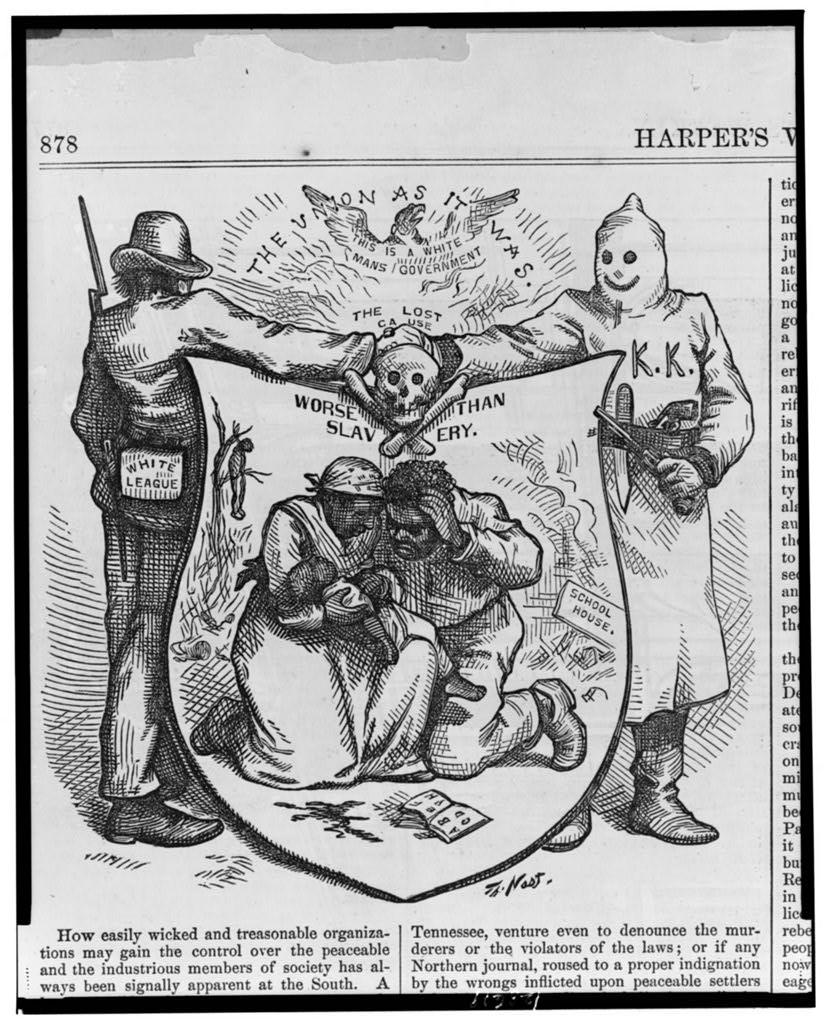
The Union as It Was / This Is a White Man's Government / Worse than Slavery 1874
Thomas Nast, Harper's Weekly, October 24, 1874. Library of Congress, Prints and Photographs Division (no known restrictions on publication).
What it shows: A member of the White League and a member of the Ku Klux Klan shake hands above a shield labeled "Worse than slavery." On the shield, a Black family grieves, with a lynching and a burned schoolhouse behind them. (This cartoon depicts racial violence.)
What it references: Violence by white supremacist groups during Reconstruction to stop Black citizens from voting, learning, and holding office.
Constitutional concept: The 14th and 15th Amendments promised equal protection and voting rights, but without enforcement they were ignored. Congress passed the Enforcement Acts (1870-1871) against the Klan; the Voting Rights Act of 1965 later enforced the 15th Amendment. (Principle: Rule of law)
Think about it: Why would Nast call conditions for Black Southerners "worse than slavery" in 1874?
Show an answer
Constitutional rights existed on paper, but terror groups were using violence to take them away while the federal government was pulling back from enforcement.
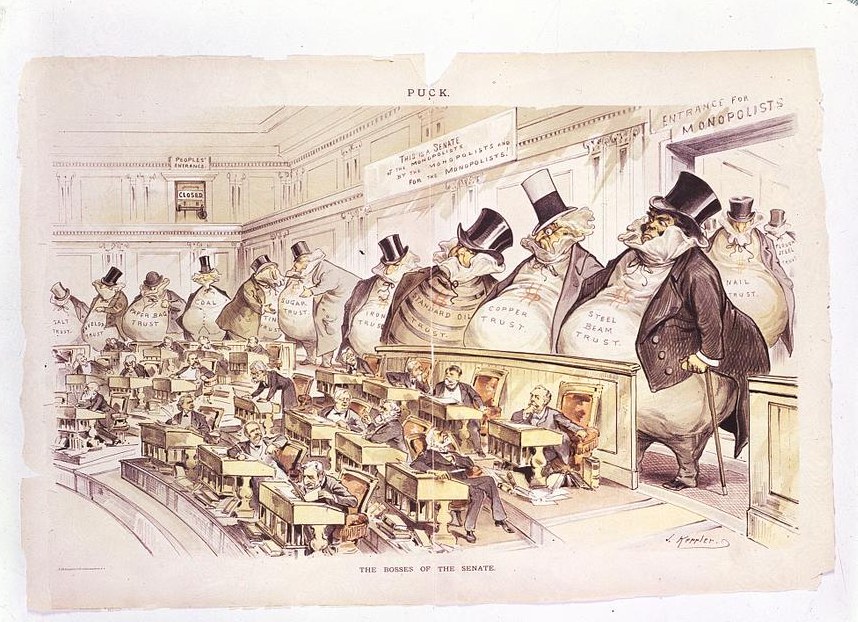
Joseph Keppler, Puck, January 23, 1889. Library of Congress, Prints and Photographs Division (no known restrictions on publication).
What it shows: Huge money-bag men labeled as trusts (Standard Oil, Sugar, Steel Beam, Copper, and others) tower over small senators. A sign reads "This is a Senate of the Monopolists by the Monopolists and for the Monopolists!" The "People's Entrance" is closed; the "Entrance for Monopolists" is open.
What it references: The power of big business trusts over the U.S. Senate in the Gilded Age. Senators were then chosen by state legislatures, which trusts could influence. The sign parodies Lincoln's Gettysburg Address.
Constitutional concept:Popular sovereignty and the 17th Amendment (1913), which gave the people the right to elect senators directly. Also the Sherman Antitrust Act (1890), passed under the Commerce Clause. (Principle: Popular sovereignty)
Think about it: Which constitutional amendment addressed the problem this cartoon shows, and how?
Show an answer
The 17th Amendment (1913): senators are elected directly by the people instead of by state legislatures.
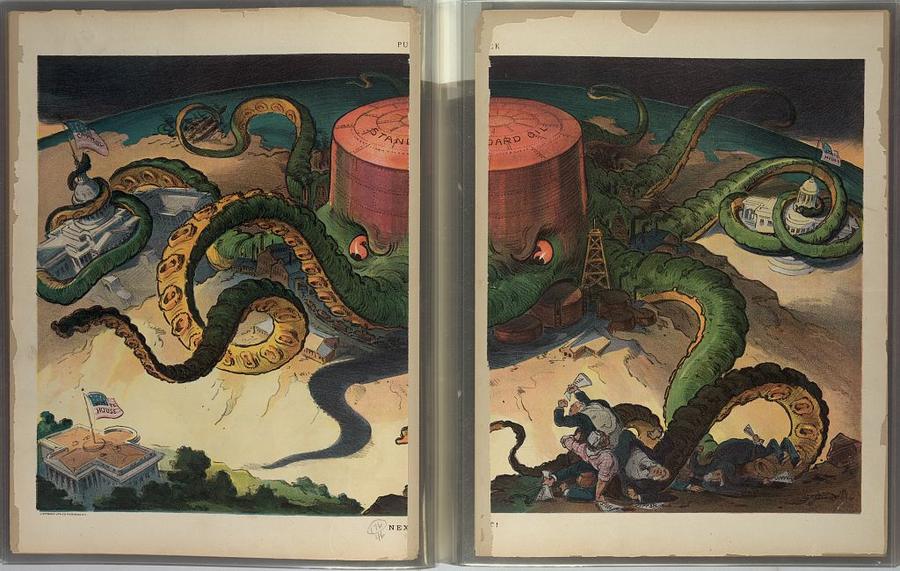
Udo J. Keppler, Puck, September 7, 1904. Library of Congress, Prints and Photographs Division (no known restrictions on publication).
What it shows: A giant octopus with a Standard Oil storage tank for a head wraps its tentacles around the U.S. Capitol and a state capitol and reaches for the White House.
What it references: John D. Rockefeller's Standard Oil trust and its influence over Congress and state legislatures. "Next!" suggests the presidency is its next target. The Supreme Court broke up Standard Oil under the Sherman Antitrust Act in 1911.
Constitutional concept: Concentrated private power threatening popular sovereignty and representative government; Congress's power to regulate interstate commerce (the Commerce Clause) as the basis of antitrust law. (Principle: Popular sovereignty)
Think about it: What do the tentacles around government buildings suggest?
Show an answer
That one corporation controlled lawmakers at both the national and state levels and was reaching for the executive branch too.
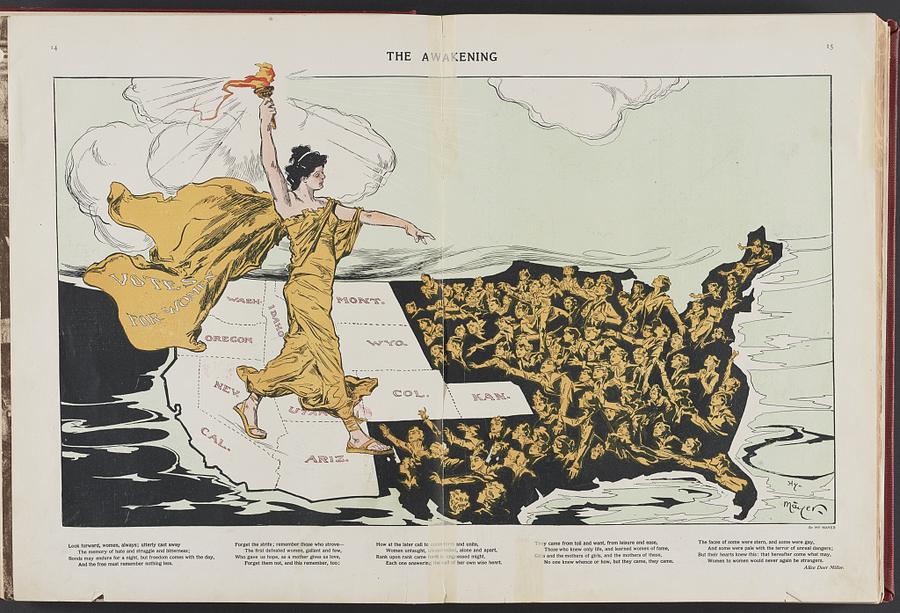
Henry "Hy" Mayer, Puck, February 20, 1915. Library of Congress, Prints and Photographs Division (no known restrictions on publication).
What it shows: A torch-bearing woman in a cape labeled "Votes for Women" strides across the western states, shown in white because women there could already vote. The eastern states are dark, filled with women reaching toward her.
What it references: The women's suffrage movement. By 1915, most western states (Wyoming first, as a territory in 1869 and a state in 1890) had given women full voting rights, while most eastern states had not.
Constitutional concept:Federalism: states set voting rules and could expand suffrage before the nation did. The 19th Amendment (1920) then barred denying the vote "on account of sex" everywhere. (Principle: Federalism)
Think about it: Why are the western states light and the eastern states dark?
Show an answer
Women could already vote in the western states; the light (the torch of liberty) was spreading east, pushing for a national amendment.
All images come from the Library of Congress Prints and Photographs Division, which lists each one as having "no known restrictions on publication." Click any image to see it full size, or follow the Library of Congress link for the original scan.
A requested World War II-era cartoon about President Truman and the Office of Price Administration (OPA) was not used because we could not verify that it is in the public domain.
We also looked for cartoons about Franklin Roosevelt's 1937 court-packing plan; the Library of Congress copies we found carry publication restrictions, so they are not reproduced here.