FCLE Cram Guide
A free 20-page review of everything high-yield for the Florida Civic Literacy Exam: a study plan, the trap pairs, and every case, amendment, and founding document you need. Read it right here on any phone or computer, or download the PDF (156 KB) to keep. Made by Daniel Tarvin, an SPC (St. Petersburg College) engineering student (about me).
Text version of the cram guide (for screen readers and copying)
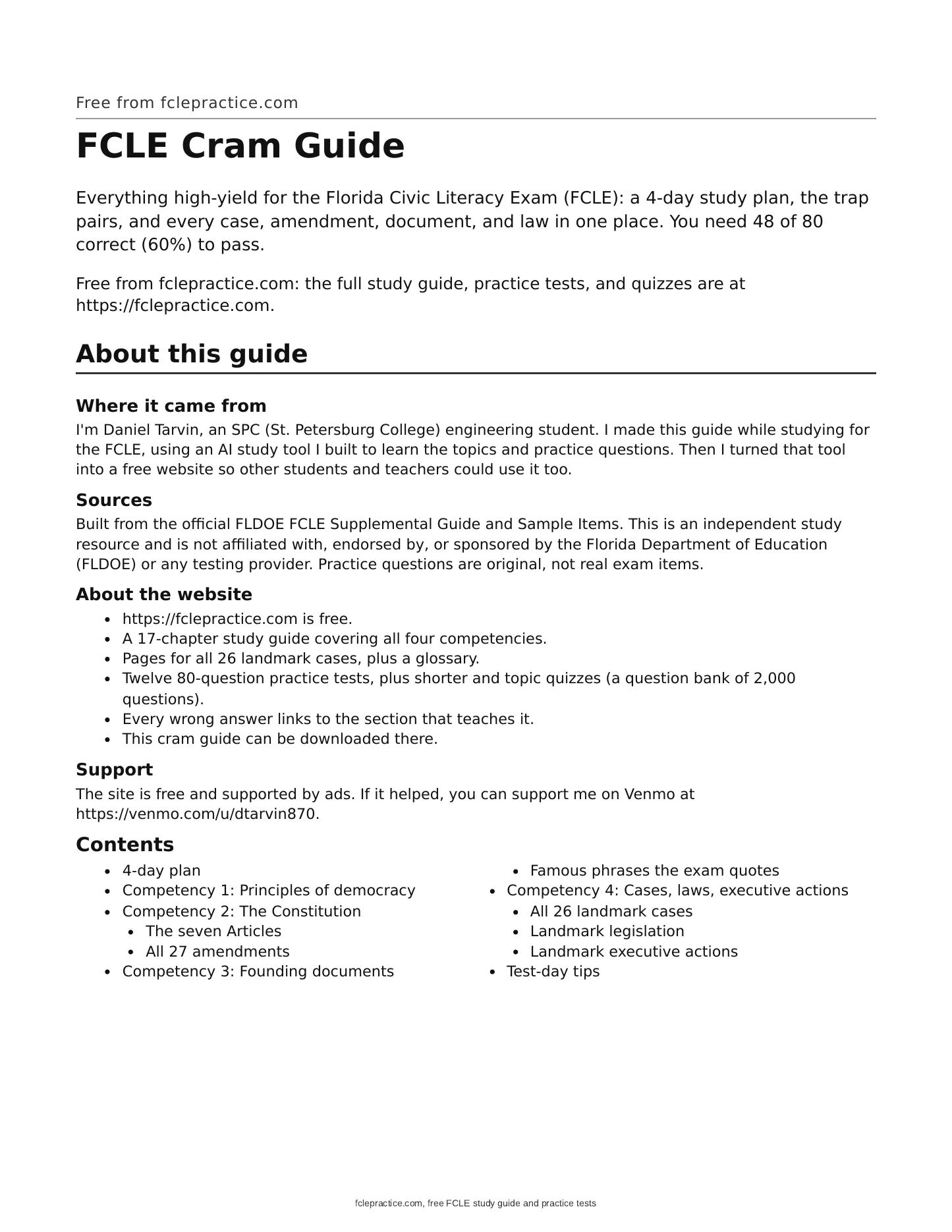
Page 1: FCLE Cram Guide
Everything high-yield for your Florida Civic Literacy Exam on Friday, Oct 30 at 11am at SPC
Tarpon Springs (AD building): a 4-day plan, the trap pairs, and every case, amendment,
document, and law in one place. You need 48 of 80 (60%).
Free from fclepractice.com: the full study guide, practice tests, and quizzes are at
https://fclepractice.com.
About this guide
Where it came from
I'm Daniel Tarvin, an SPC (St. Petersburg College) engineering student. I made this guide while studying for
the FCLE, using an AI study tool I built to learn the topics and practice questions. Then I turned that tool
into a free website so other students and teachers could use it too.
Sources
Built from the official FLDOE FCLE Supplemental Guide and Sample Items. This is an independent study
resource and is not affiliated with, endorsed by, or sponsored by the Florida Department of Education
(FLDOE) or any testing provider. Practice questions are original, not real exam items.
About the website
https://fclepractice.com is free.
A 17-chapter study guide covering all four competencies.
Pages for all 26 landmark cases, plus a glossary.
Twelve 80-question practice tests, plus shorter and topic quizzes (a question bank of about 1,000
questions).
Every wrong answer links to the section that teaches it.
This cram guide can be downloaded there.
Support
The site is free and supported by ads. If it helped, you can support me on Venmo at
https://venmo.com/u/dtarvin870.
Contents
4-day plan
Competency 1: Principles of democracy
Competency 2: The Constitution
The seven Articles
All 27 amendments
Competency 3: Founding documents
Famous phrases the exam quotes
Competency 4: Cases, laws, executive actions
All 26 landmark cases
Landmark legislation
Landmark executive actions
Test-day tips
Must-know on Friday morning
fclepractice.com, free FCLE study guide and practice tests
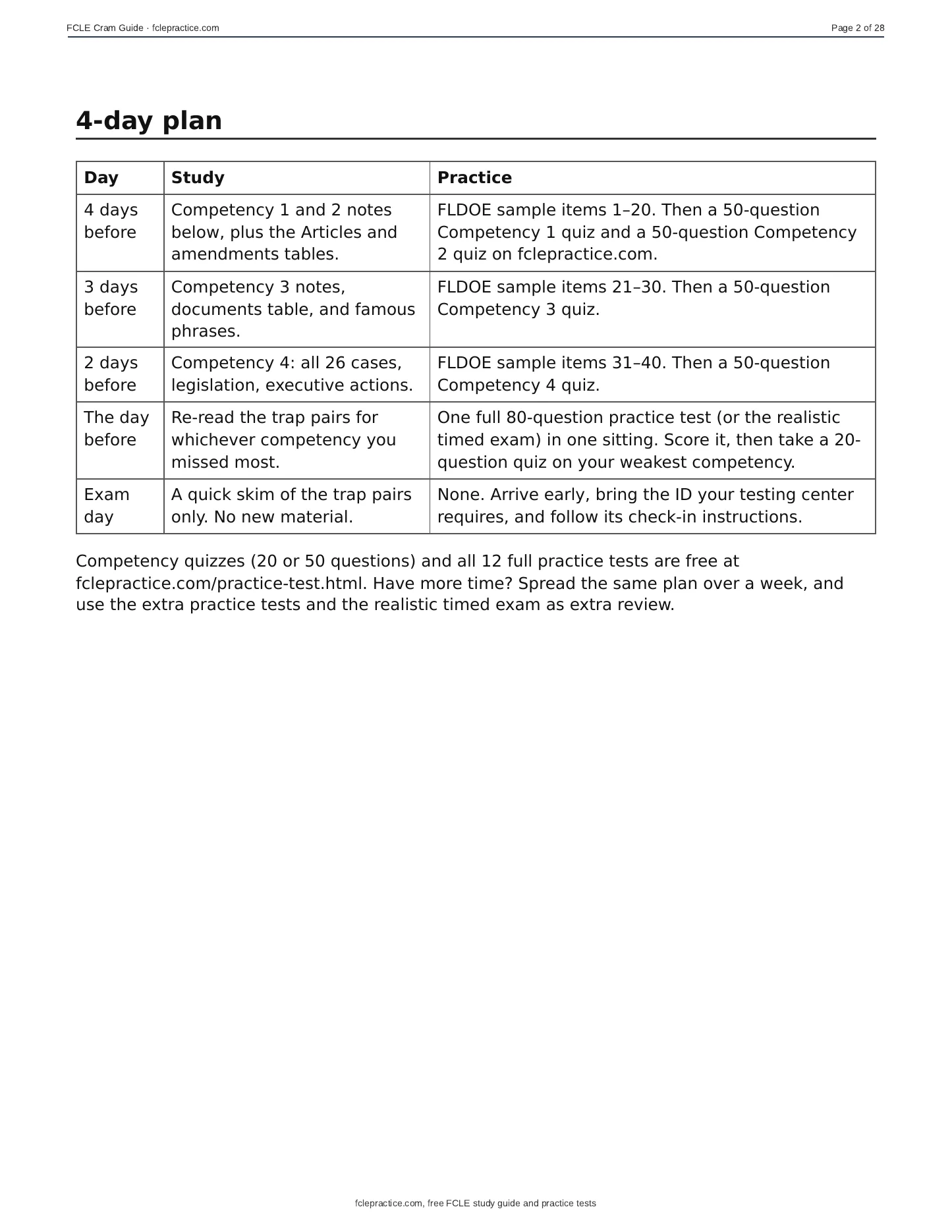
Page 2: 4-day plan
Day
Study
Practice
Mon
Oct 26
Competency 1 and 2 notes below,
plus the Articles and amendments
tables.
FLDOE sample items 1–20. Practice Tests 1 and
2: do only items tagged C1 or C2 in the answer
key (80 items).
Tue
Oct 27
Competency 3 notes, documents
table, and famous phrases.
FLDOE sample items 21–30. Practice Tests 3 and
4: C3 items only (40 items).
Wed
Oct 28
Competency 4: all 26 cases,
legislation, executive actions.
FLDOE sample items 31–40. Practice Tests 5 and
6: C4 items only (40 items).
Thu
Oct 29
Re-read the trap pairs for
whichever competency you missed
most.
Practice Test 7, all 80, in one sitting. Score it,
then redo the weakest competency's items from
Practice Test 8.
Fri Oct
30
Must-know list at the bottom of this
page only. No new material.
None. Arrive early at the AD building for 11am.
Each answer key line is tagged C1 to C4, so you can filter items by competency; the
spreadsheet's competency column does the same. Tests 9 to 12 and the bonus set are spares if
you finish early.
fclepractice.com, free FCLE study guide and practice tests
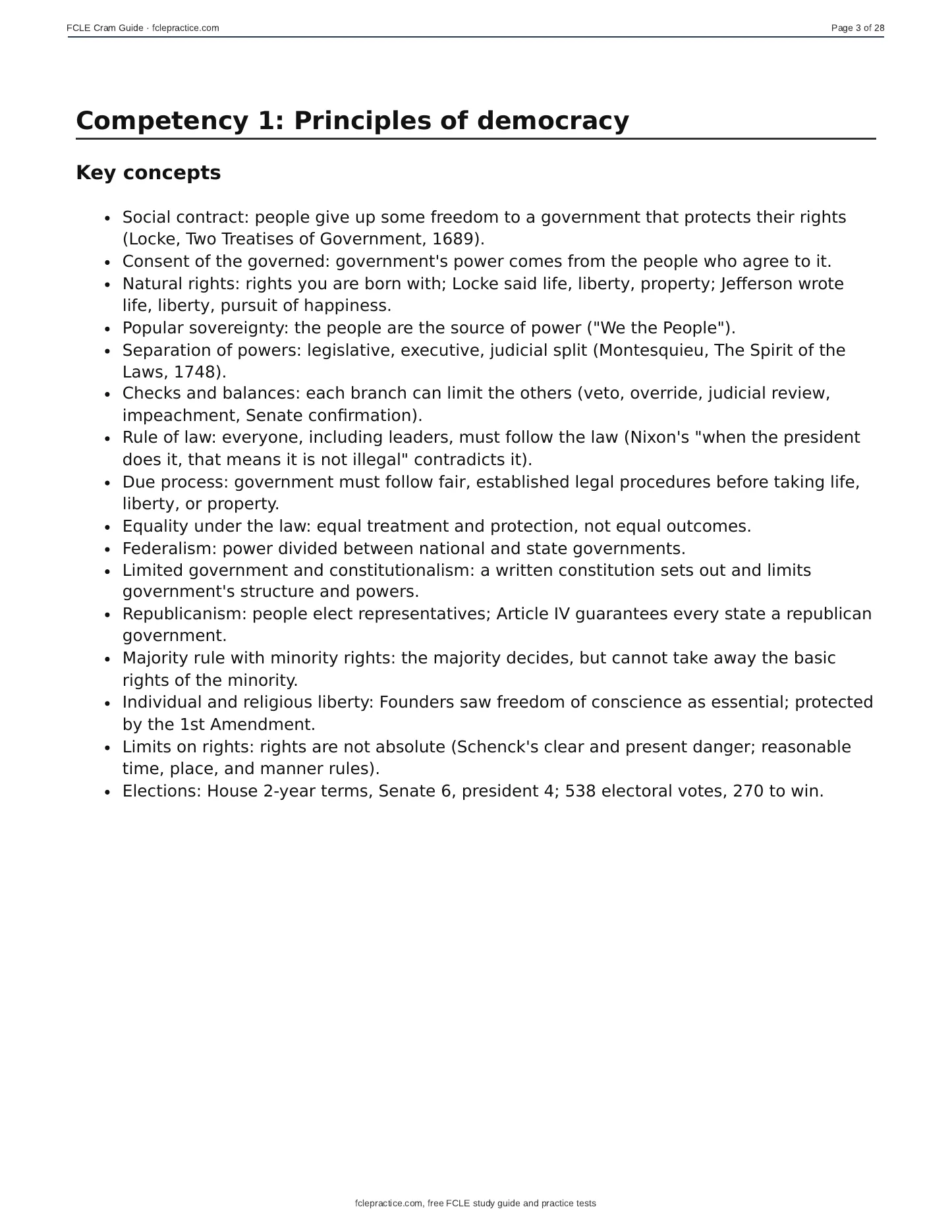
Page 3: Competency 1: Principles of democracy
Key concepts
Social contract: people give up some freedom to a government that protects their rights
(Locke, Two Treatises of Government, 1689).
Consent of the governed: government's power comes from the people who agree to it.
Natural rights: rights you are born with; Locke said life, liberty, property; Jefferson wrote
life, liberty, pursuit of happiness.
Popular sovereignty: the people are the source of power ("We the People").
Separation of powers: legislative, executive, judicial split (Montesquieu, The Spirit of the
Laws, 1748).
Checks and balances: each branch can limit the others (veto, override, judicial review,
impeachment, Senate confirmation).
Rule of law: everyone, including leaders, must follow the law (Nixon's "when the president
does it, that means it is not illegal" contradicts it).
Due process: government must follow fair, established legal procedures before taking life,
liberty, or property.
Equality under the law: equal treatment and protection, not equal outcomes.
Federalism: power divided between national and state governments.
Limited government and constitutionalism: a written constitution sets out and limits
government's structure and powers.
Republicanism: people elect representatives; Article IV guarantees every state a republican
government.
Majority rule with minority rights: the majority decides, but cannot take away the basic
rights of the minority.
Individual and religious liberty: Founders saw freedom of conscience as essential; protected
by the 1st Amendment.
Limits on rights: rights are not absolute (Schenck's clear and present danger; reasonable
time, place, and manner rules).
Elections: House 2-year terms, Senate 6, president 4; 538 electoral votes, 270 to win.
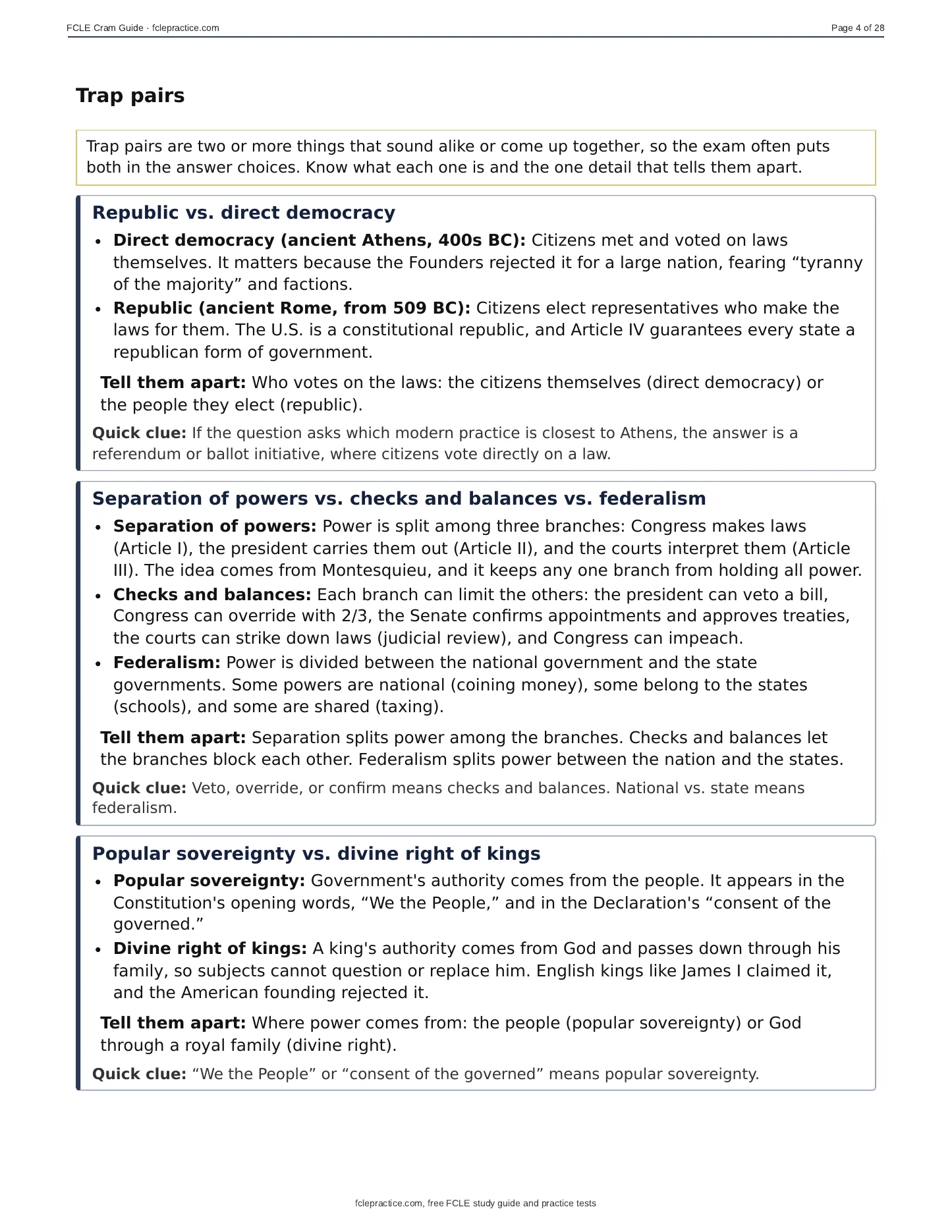
Trap pairs
Trap pair
How to tell them apart
Republic vs. direct
democracy
Rome was a republic (elected representatives). Athens was a
direct democracy (citizens voted themselves). The U.S. is a
constitutional republic; the Founders feared majority tyranny
and factions.
Modern practice closest
to Athens
The referendum or ballot initiative, where citizens vote directly
on a law.
Separation of powers vs.
checks and balances vs.
federalism
Split among branches vs. branches limiting each other vs. split
between national and state governments.
fclepractice.com, free FCLE study guide and practice tests
Page 4: Trap pair
How to tell them apart
Popular sovereignty vs.
divine right of kings
Power from the people vs. power from God through inherited
monarchy.
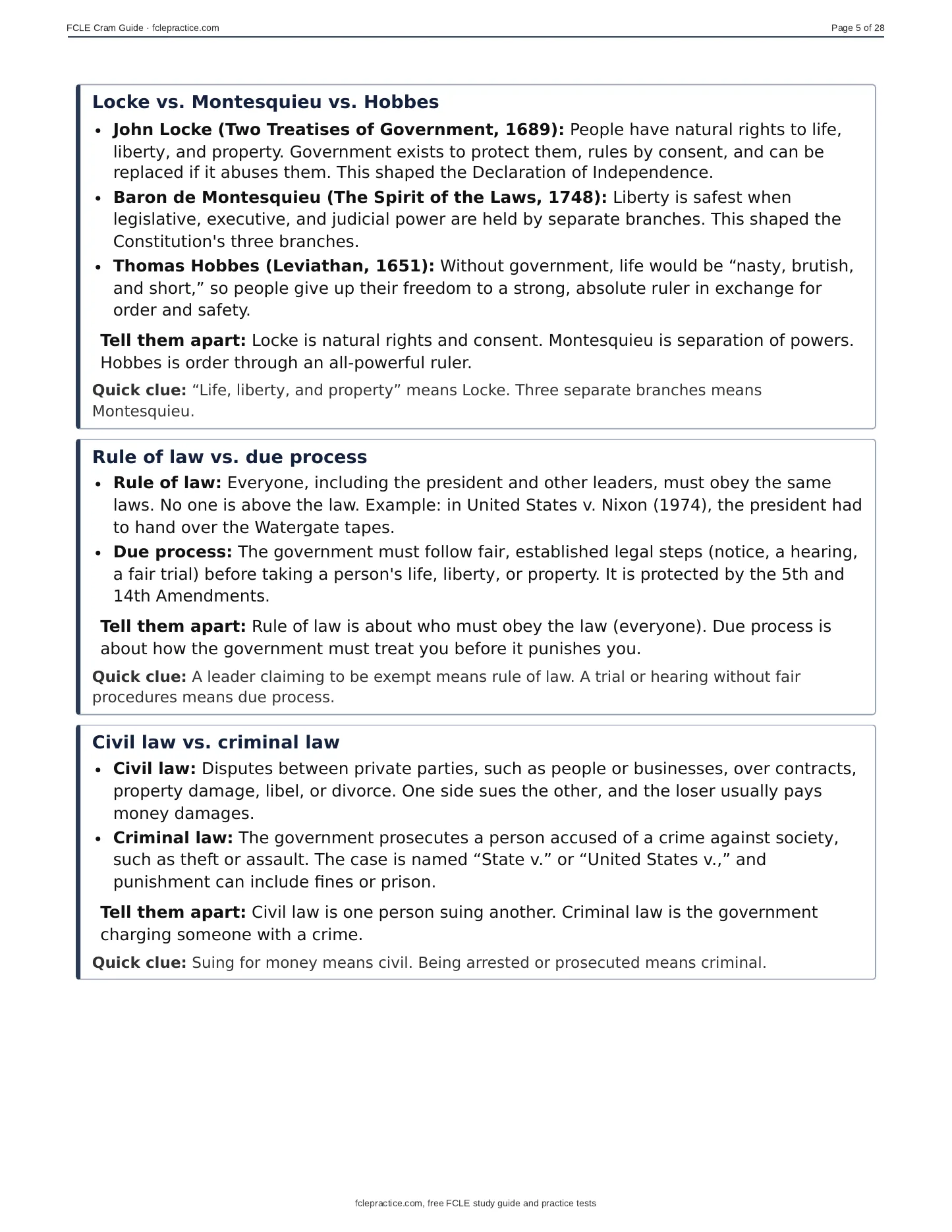
Locke vs. Montesquieu
vs. Hobbes
Locke: natural rights and consent. Montesquieu: separation of
powers. Hobbes: people give power to an absolute ruler for
order.
Rule of law vs. due
process
No one is above the law vs. fair procedures before punishment.
Civil law vs. criminal law
Disputes between people (libel, contracts, property damage) vs.
crimes prosecuted by the government.
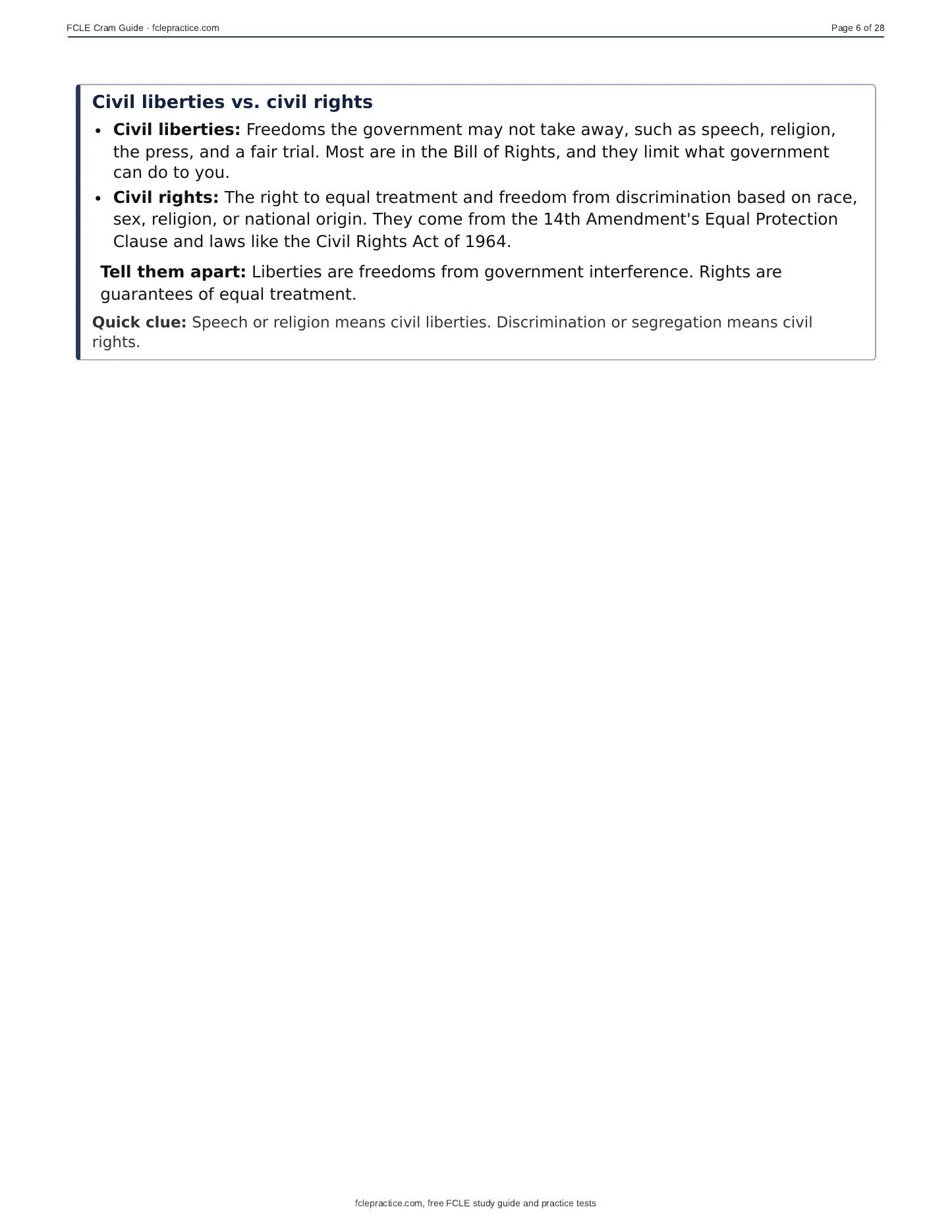
Civil liberties vs. civil
rights
Freedoms protected from government (speech, religion) vs.
equal treatment and protection from discrimination.
fclepractice.com, free FCLE study guide and practice tests
Page 5: Competency 2: The Constitution
Key concepts
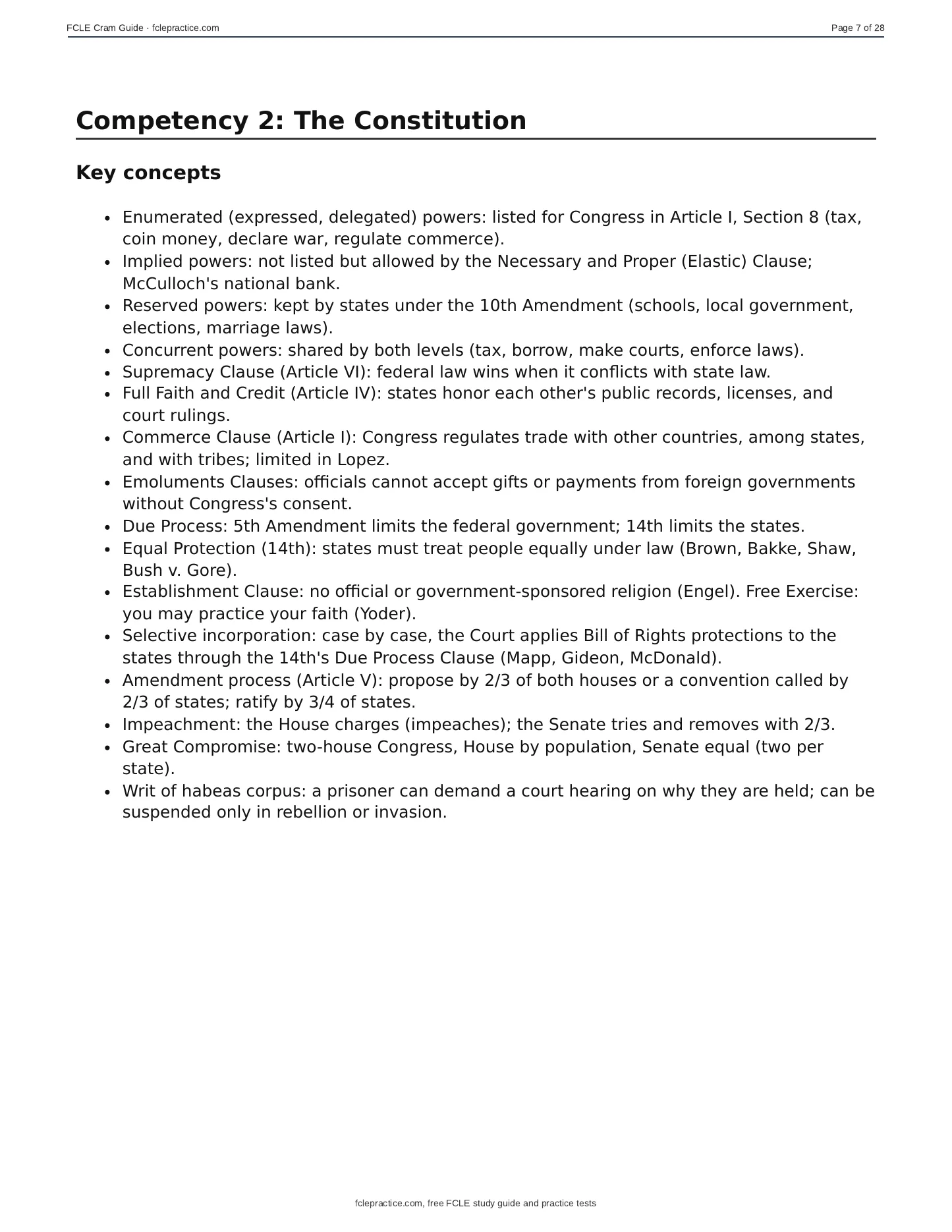
Enumerated (expressed, delegated) powers: listed for Congress in Article I, Section 8 (tax,
coin money, declare war, regulate commerce).
Implied powers: not listed but allowed by the Necessary and Proper (Elastic) Clause;
McCulloch's national bank.
Reserved powers: kept by states under the 10th Amendment (schools, local government,
elections, marriage laws).
Concurrent powers: shared by both levels (tax, borrow, make courts, enforce laws).
Supremacy Clause (Article VI): federal law wins when it conflicts with state law.
Full Faith and Credit (Article IV): states honor each other's public records, licenses, and
court rulings.
Commerce Clause (Article I): Congress regulates trade with other countries, among states,
and with tribes; limited in Lopez.
Emoluments Clauses: officials cannot accept gifts or payments from foreign governments
without Congress's consent.
Due Process: 5th Amendment limits the federal government; 14th limits the states.
Equal Protection (14th): states must treat people equally under law (Brown, Bakke, Shaw,
Bush v. Gore).
Establishment Clause: no official or government-sponsored religion (Engel). Free Exercise:
you may practice your faith (Yoder).
Selective incorporation: case by case, the Court applies Bill of Rights protections to the
states through the 14th's Due Process Clause (Mapp, Gideon, McDonald).
Amendment process (Article V): propose by 2/3 of both houses or a convention called by
2/3 of states; ratify by 3/4 of states.
Impeachment: the House charges (impeaches); the Senate tries and removes with 2/3.
Great Compromise: two-house Congress, House by population, Senate equal (two per
state).
Writ of habeas corpus: a prisoner can demand a court hearing on why they are held; can be
suspended only in rebellion or invasion.
Trap pairs
Trap pair
How to tell them apart
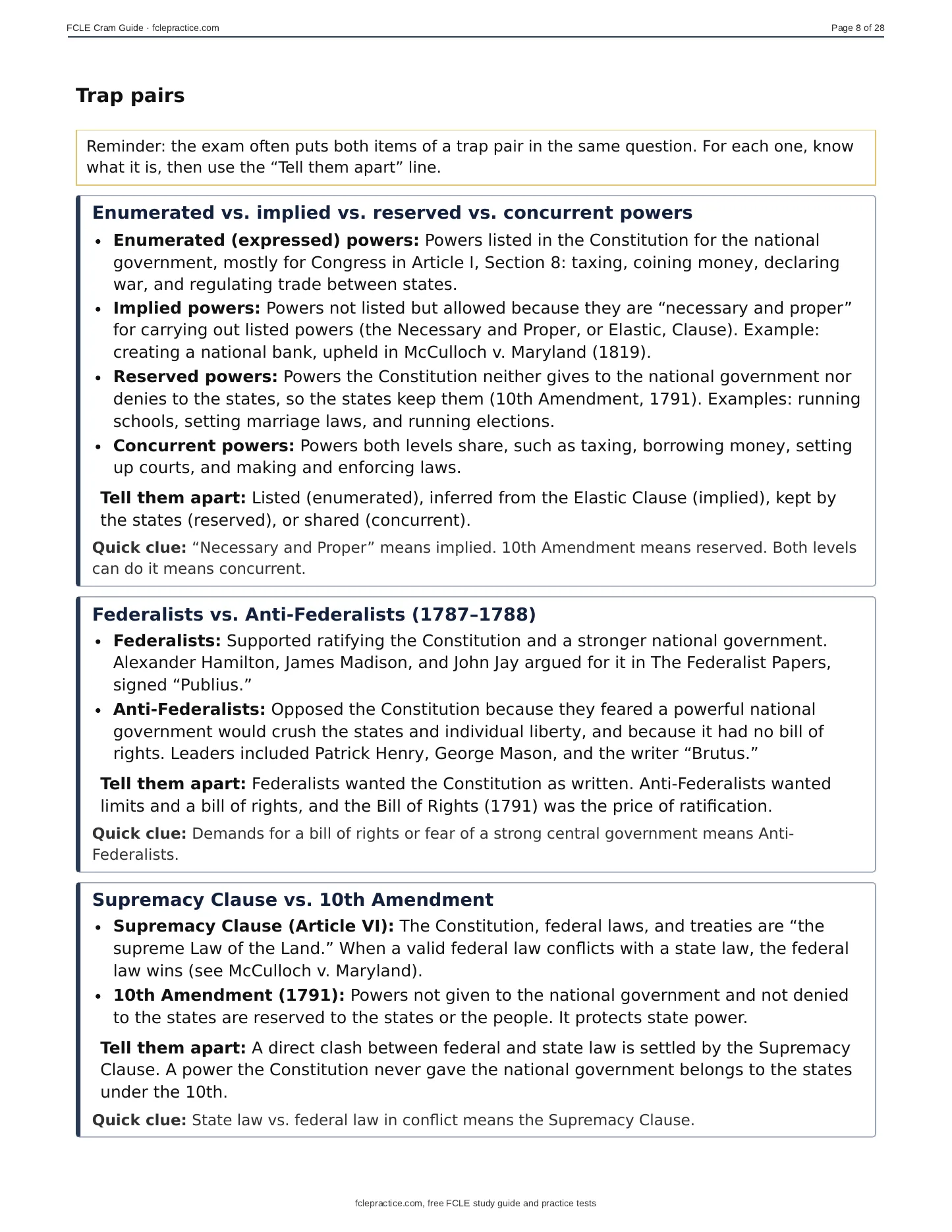
Enumerated vs.
implied vs. reserved
vs. concurrent
Listed for Congress vs. inferred from the Elastic Clause vs. kept by
states (10th) vs. shared by both.
Federalists vs. AntiFederalists
Federalists (Hamilton, Madison, Jay) backed the Constitution and a
strong national government. Anti-Federalists (Patrick Henry,
George Mason, "Brutus") feared it and demanded a bill of rights;
the Bill of Rights was the price of ratification.
Supremacy Clause vs.
10th Amendment
State-federal conflict is resolved by Supremacy; the 10th only
covers powers not given to the federal government.
fclepractice.com, free FCLE study guide and practice tests
Page 6: Trap pair
How to tell them apart
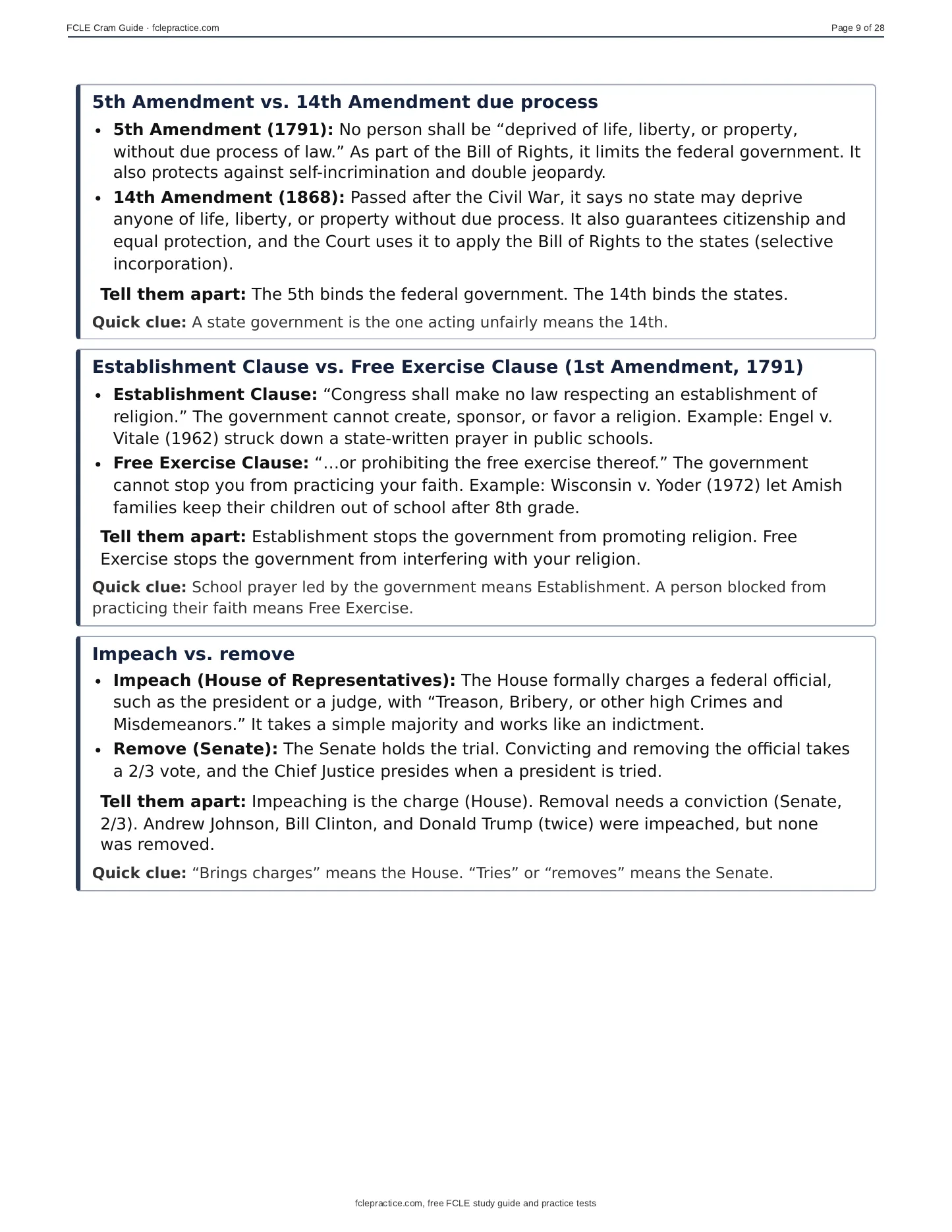
5th vs. 14th
Amendment due
process
5th binds the federal government; 14th binds the states.
Establishment vs. Free
Exercise
Government cannot promote religion vs. government cannot stop
you practicing it.
Impeach vs. remove
House impeaches (charges); Senate convicts and removes.
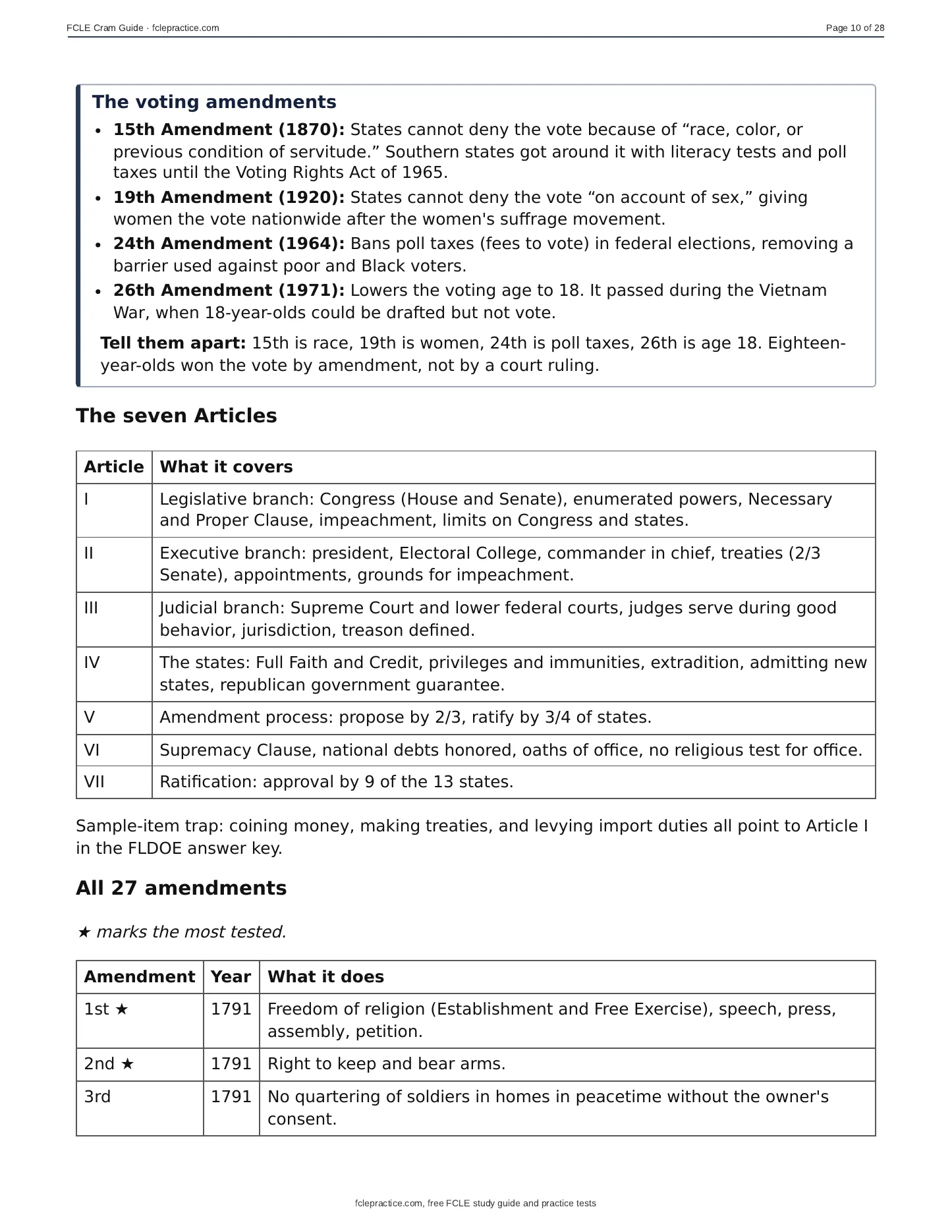
Voting amendments
15th race, 19th women, 24th poll tax, 26th age 18. Eighteen-yearolds won the vote by amendment, not a court ruling.
The seven Articles
Article What it covers
I
Legislative branch: Congress (House and Senate), enumerated powers, Necessary
and Proper Clause, impeachment, limits on Congress and states.
II
Executive branch: president, Electoral College, commander in chief, treaties (2/3
Senate), appointments, grounds for impeachment.
III
Judicial branch: Supreme Court and lower federal courts, judges serve during good
behavior, jurisdiction, treason defined.
IV
The states: Full Faith and Credit, privileges and immunities, extradition, admitting new
states, republican government guarantee.
V
Amendment process: propose by 2/3, ratify by 3/4 of states.
VI
Supremacy Clause, national debts honored, oaths of office, no religious test for office.
VII
Ratification: approval by 9 of the 13 states.
Sample-item trap: coining money, making treaties, and levying import duties all point to Article I
in the FLDOE answer key.
All 27 amendments
★ marks the most tested.
Amendment Year What it does
1st ★
1791 Freedom of religion (Establishment and Free Exercise), speech, press,
assembly, petition.
2nd ★
1791 Right to keep and bear arms.
3rd
1791 No quartering of soldiers in homes in peacetime without the owner's
consent.
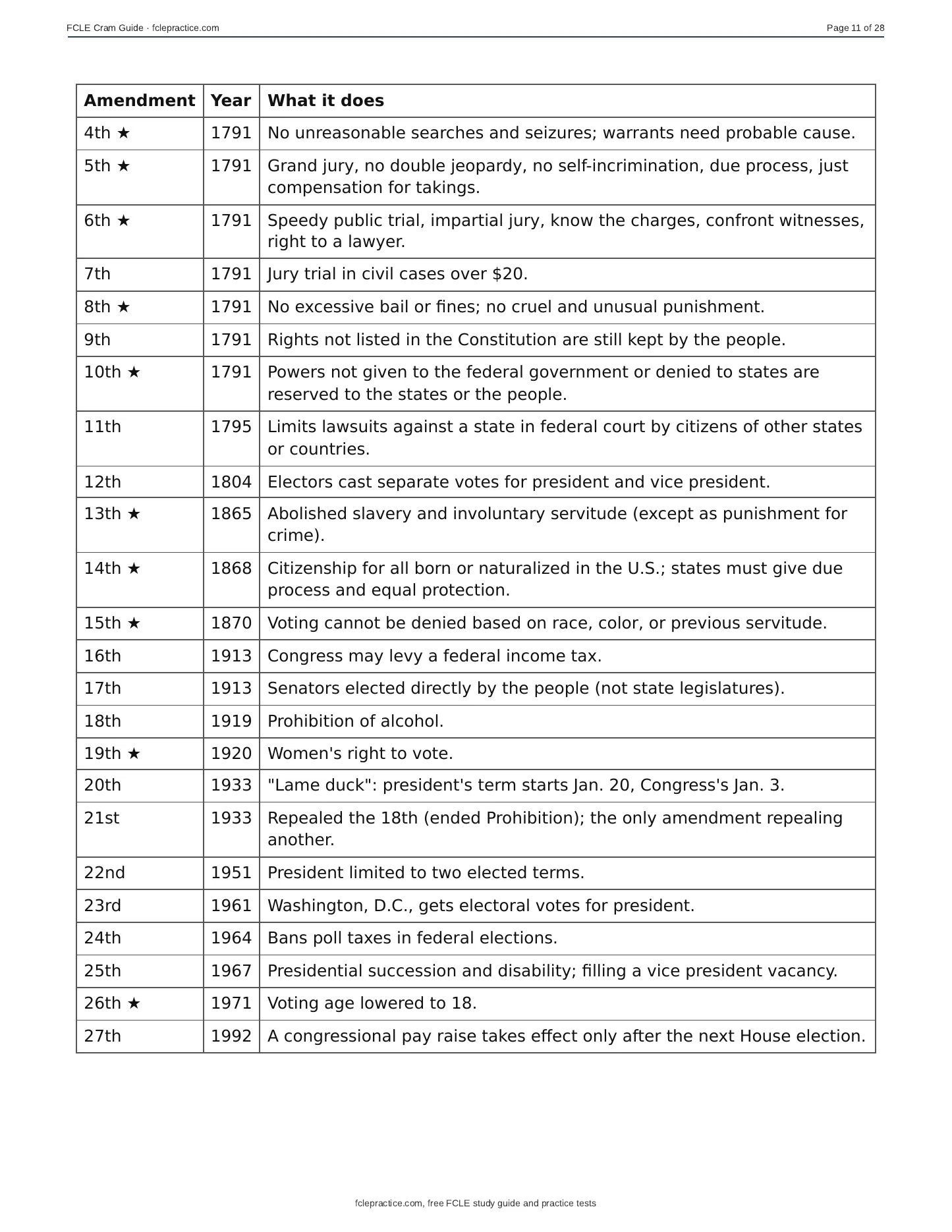
4th ★
1791 No unreasonable searches and seizures; warrants need probable cause.
fclepractice.com, free FCLE study guide and practice tests
Page 7: Amendment Year What it does
5th ★
1791 Grand jury, no double jeopardy, no self-incrimination, due process, just
compensation for takings.
6th ★
1791 Speedy public trial, impartial jury, know the charges, confront witnesses,
right to a lawyer.
7th
1791 Jury trial in civil cases over $20.
8th ★
1791 No excessive bail or fines; no cruel and unusual punishment.
9th
1791 Rights not listed in the Constitution are still kept by the people.
10th ★
1791 Powers not given to the federal government or denied to states are
reserved to the states or the people.
11th
1795 Limits lawsuits against a state in federal court by citizens of other states
or countries.
12th
1804 Electors cast separate votes for president and vice president.
13th ★
1865 Abolished slavery and involuntary servitude (except as punishment for
crime).
14th ★
1868 Citizenship for all born or naturalized in the U.S.; states must give due
process and equal protection.
15th ★
1870 Voting cannot be denied based on race, color, or previous servitude.
16th
1913 Congress may levy a federal income tax.
17th
1913 Senators elected directly by the people (not state legislatures).
18th
1919 Prohibition of alcohol.
19th ★
1920 Women's right to vote.
20th
1933 "Lame duck": president's term starts Jan. 20, Congress's Jan. 3.
21st
1933 Repealed the 18th (ended Prohibition); the only amendment repealing
another.
22nd
1951 President limited to two elected terms.
23rd
1961 Washington, D.C., gets electoral votes for president.
24th
1964 Bans poll taxes in federal elections.
25th
1967 Presidential succession and disability; filling a vice president vacancy.
26th ★
1971 Voting age lowered to 18.
27th
1992 A congressional pay raise takes effect only after the next House election.
fclepractice.com, free FCLE study guide and practice tests
Page 8: Competency 3: Founding documents
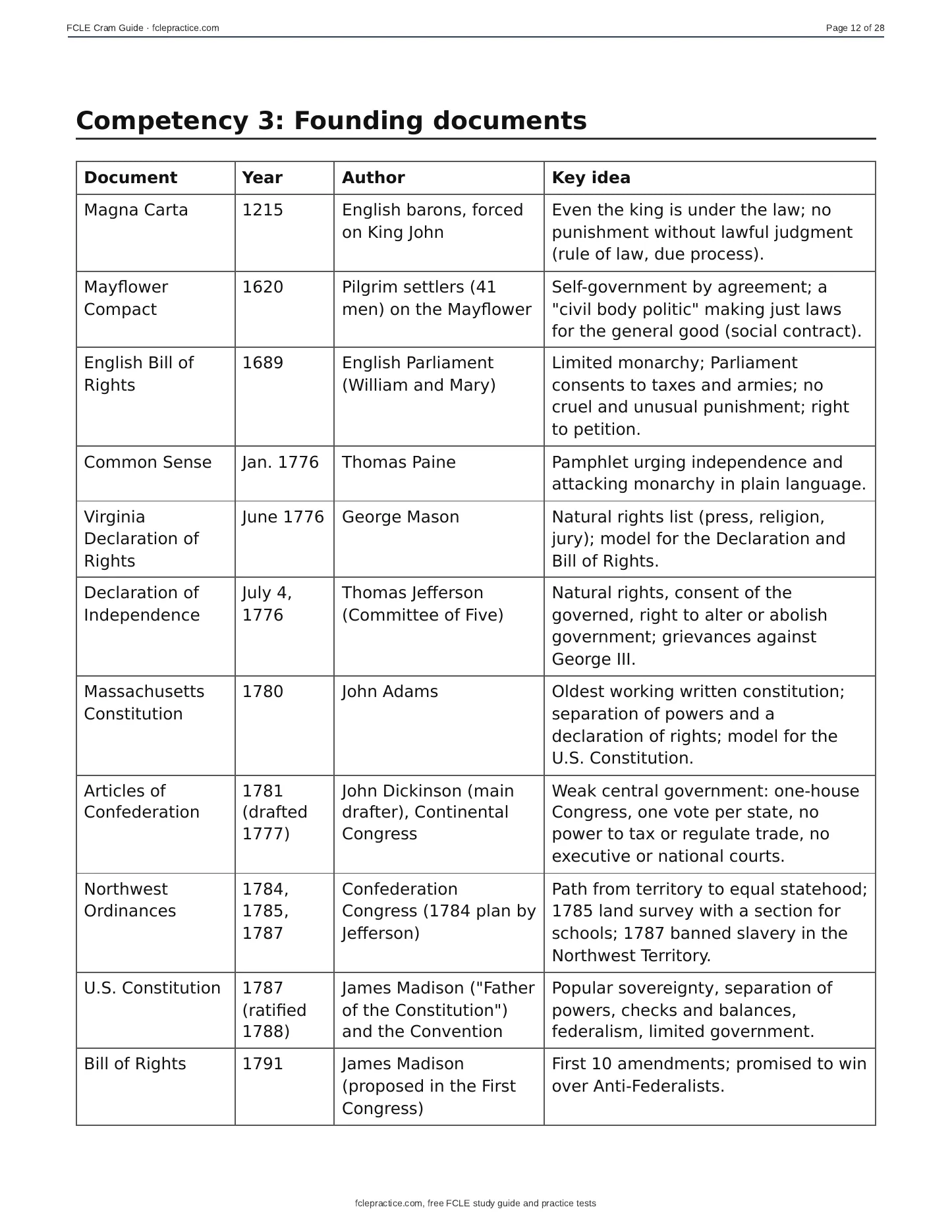
Document
Year
Author
Key idea
Magna Carta
1215
English barons, forced
on King John
Even the king is under the law; no
punishment without lawful judgment
(rule of law, due process).
Mayflower
Compact
1620
Pilgrim settlers (41
men) on the Mayflower
Self-government by agreement; a
"civil body politic" making just laws
for the general good (social contract).
English Bill of
Rights
1689
English Parliament
(William and Mary)
Limited monarchy; Parliament
consents to taxes and armies; no
cruel and unusual punishment; right
to petition.
Common Sense
Jan. 1776
Thomas Paine
Pamphlet urging independence and
attacking monarchy in plain language.
Virginia
Declaration of
Rights
June 1776
George Mason
Natural rights list (press, religion,
jury); model for the Declaration and
Bill of Rights.
Declaration of
Independence
July 4,
1776
Thomas Jefferson
(Committee of Five)
Natural rights, consent of the
governed, right to alter or abolish
government; grievances against
George III.
Massachusetts
Constitution
1780
John Adams
Oldest working written constitution;
separation of powers and a
declaration of rights; model for the
U.S. Constitution.
Articles of
Confederation
1781
(drafted
1777)
John Dickinson (main
drafter), Continental
Congress
Weak central government: one-house
Congress, one vote per state, no
power to tax or regulate trade, no
executive or national courts.
Northwest
Ordinances
1784,
1785,
1787
Confederation
Path from territory to equal statehood;
Congress (1784 plan by 1785 land survey with a section for
Jefferson)
schools; 1787 banned slavery in the
Northwest Territory.
U.S. Constitution
1787
(ratified
1788)
James Madison ("Father
of the Constitution")
and the Convention
Popular sovereignty, separation of
powers, checks and balances,
federalism, limited government.
Bill of Rights
1791
James Madison
(proposed in the First
Congress)
First 10 amendments; promised to win
over Anti-Federalists.
fclepractice.com, free FCLE study guide and practice tests
Page 9: Document
Year
Author
Key idea
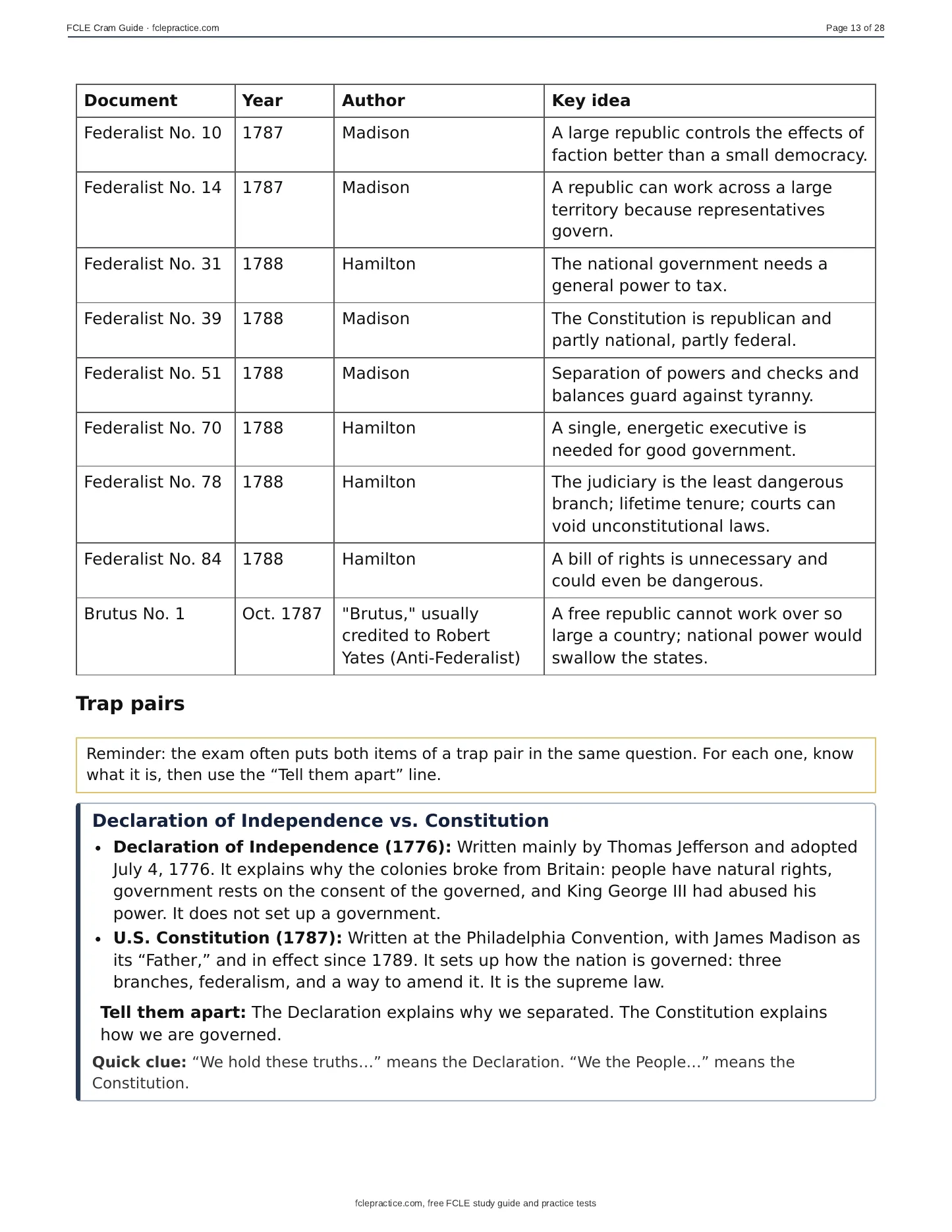
Federalist No. 10
1787
Madison
A large republic controls the effects of
faction better than a small democracy.
Federalist No. 14
1787
Madison
A republic can work across a large
territory because representatives
govern.
Federalist No. 31
1788
Hamilton
The national government needs a
general power to tax.
Federalist No. 39
1788
Madison
The Constitution is republican and
partly national, partly federal.
Federalist No. 51
1788
Madison
Separation of powers and checks and
balances guard against tyranny.
Federalist No. 70
1788
Hamilton
A single, energetic executive is
needed for good government.
Federalist No. 78
1788
Hamilton
The judiciary is the least dangerous
branch; lifetime tenure; courts can
void unconstitutional laws.
Federalist No. 84
1788
Hamilton
A bill of rights is unnecessary and
could even be dangerous.
Brutus No. 1
Oct. 1787
"Brutus," usually
credited to Robert
Yates (Anti-Federalist)
A free republic cannot work over so
large a country; national power would
swallow the states.
Trap pairs
Trap pair
How to tell them apart
Declaration vs.
Constitution
Declaration (1776, Jefferson) explains why we separated.
Constitution (1787, Madison) sets up how we are governed.
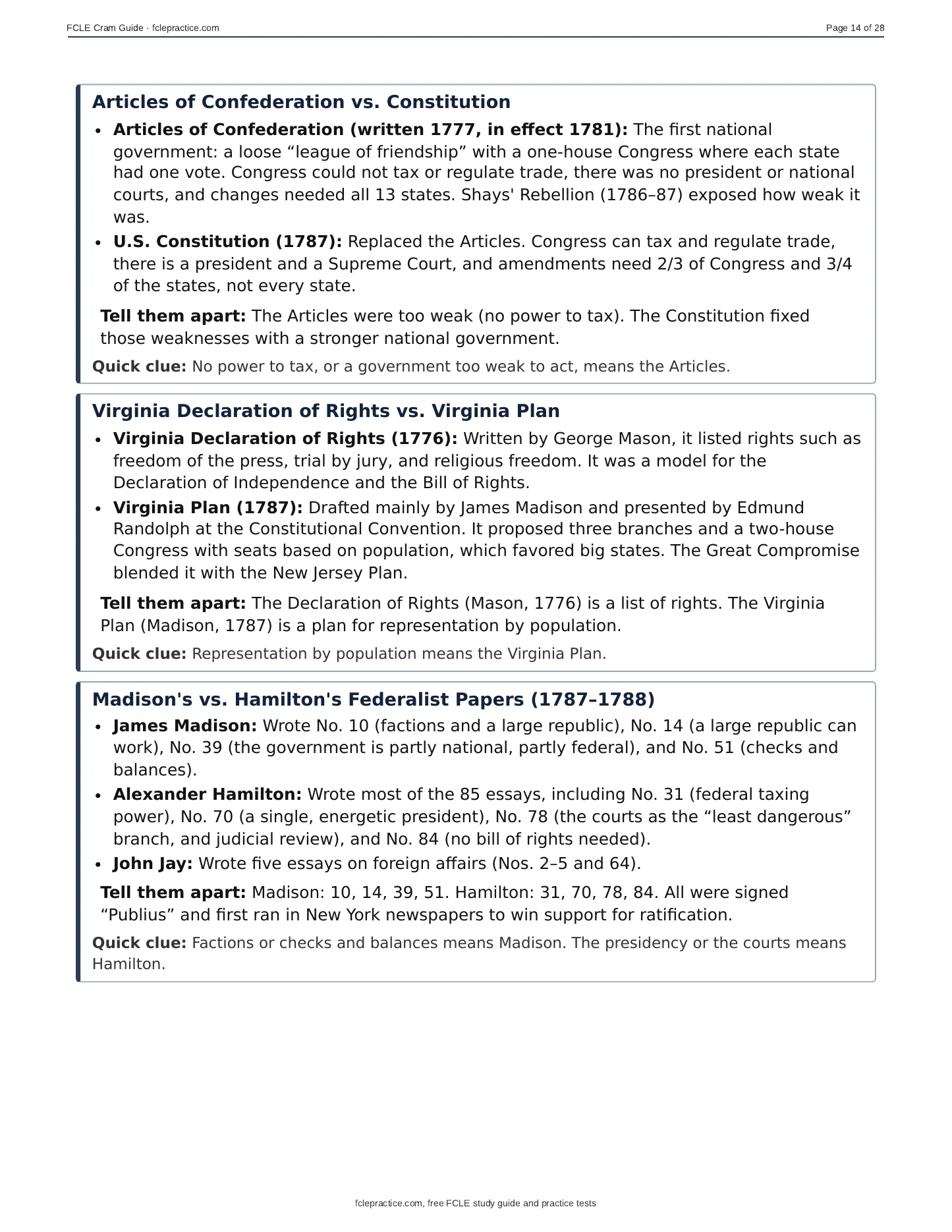
Articles of Confederation
vs. Constitution
Articles: no power to tax, no executive or courts, unanimous
vote to amend. The Constitution fixed these weaknesses.
Virginia Declaration of
Rights vs. Virginia Plan
Mason's 1776 list of rights vs. Madison's 1787 plan for
representation by population.
Madison papers vs.
Hamilton papers
Madison: 10, 14, 39, 51. Hamilton: 31, 70, 78, 84. All
Federalist essays were signed "Publius" and ran in New York
newspapers.
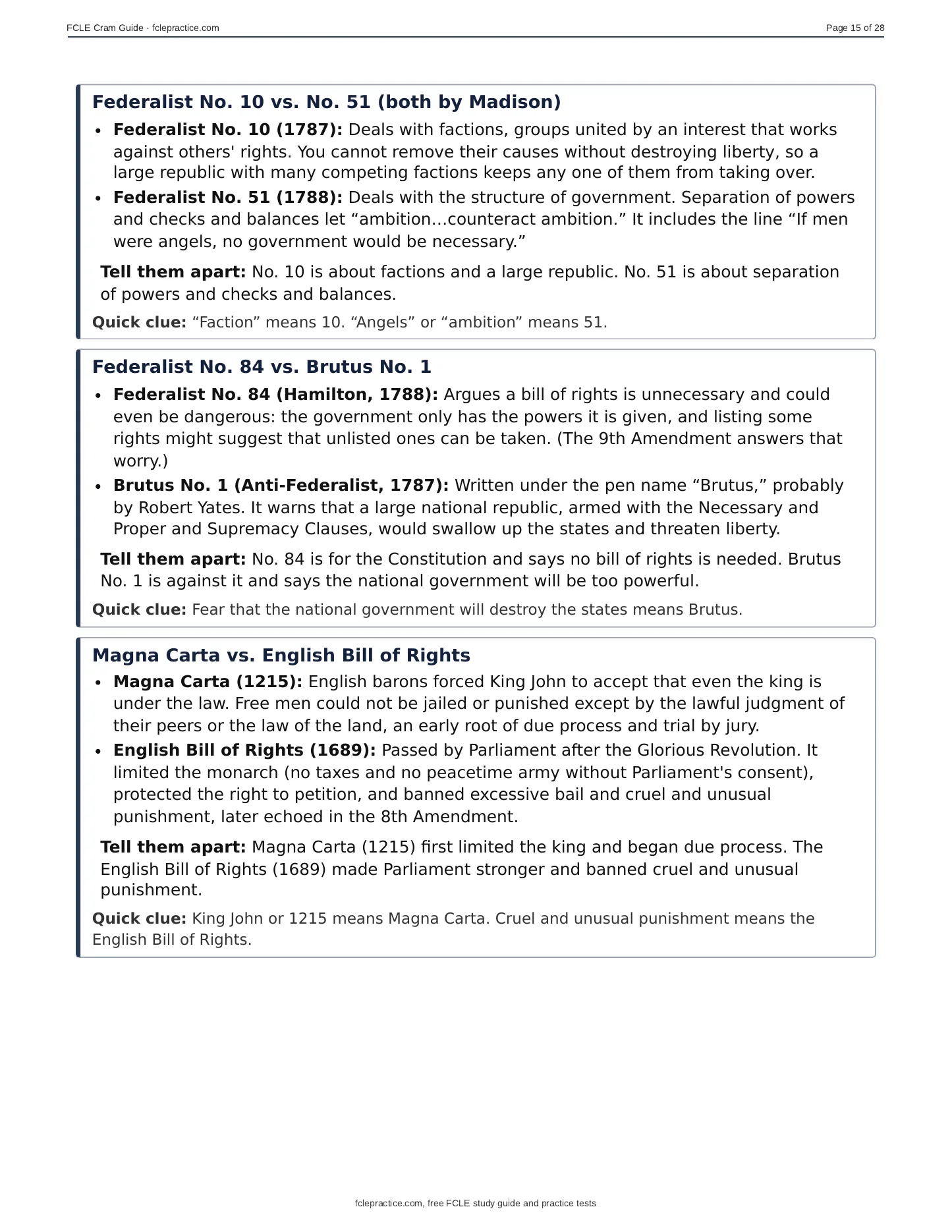
Federalist 10 vs. 51
10 is about factions and a large republic; 51 is about
separation of powers and checks and balances.
Federalist 84 vs. Brutus 1
84 says no bill of rights is needed; Brutus says a big national
government endangers liberty and the states.
fclepractice.com, free FCLE study guide and practice tests
Page 10: Trap pair
How to tell them apart
Magna Carta vs. English Bill 1215 limits the king and starts due process; 1689 strengthens
of Rights
Parliament and bans cruel and unusual punishment.
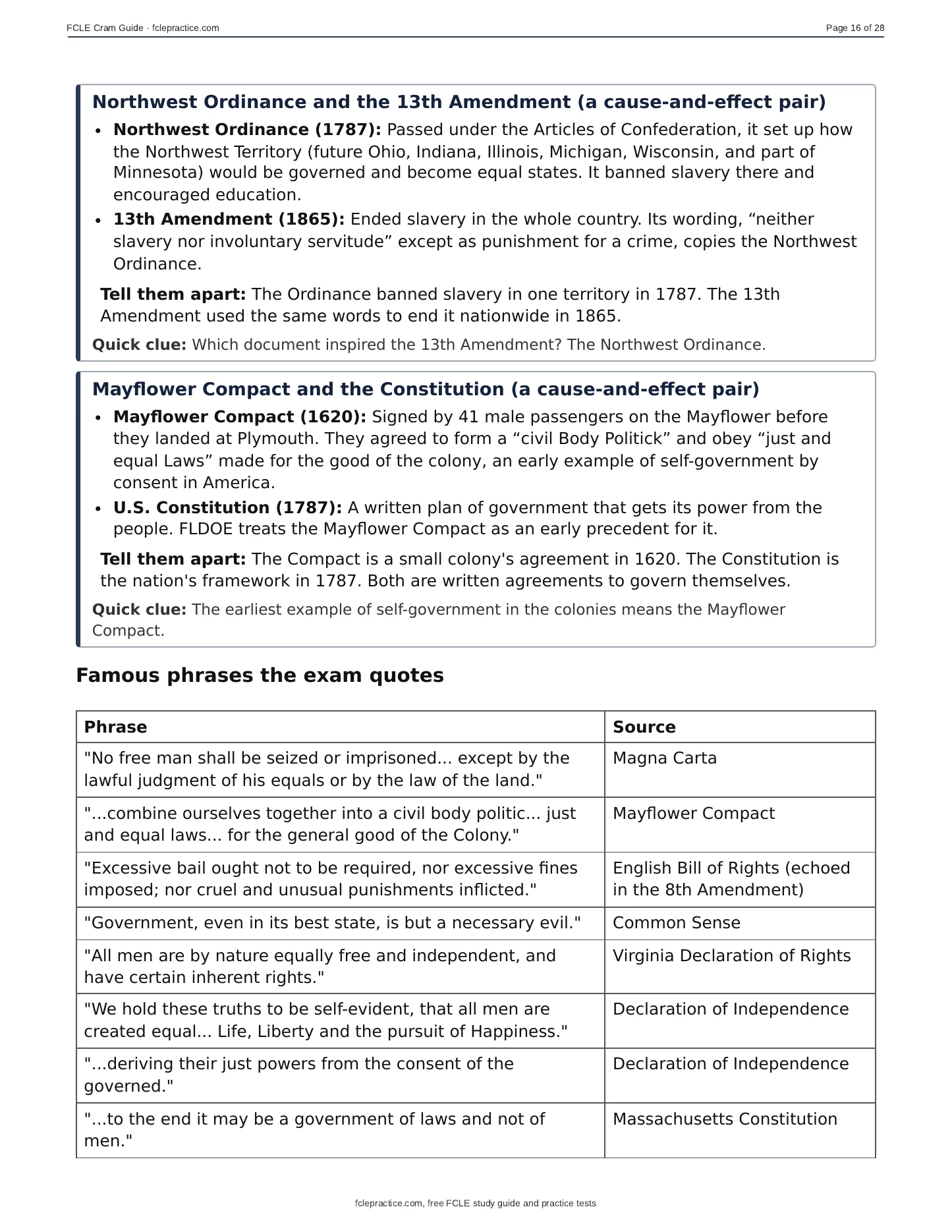
Northwest Ordinance to
13th Amendment
Its slavery ban in the territory is the language the 13th
Amendment echoes.
Mayflower Compact to
Constitution
FLDOE links the Compact to the U.S. Constitution as a
precedent for self-government.
Famous phrases the exam quotes
Phrase
Source
"No free man shall be seized or imprisoned... except by the
lawful judgment of his equals or by the law of the land."
Magna Carta
"...combine ourselves together into a civil body politic... just
and equal laws... for the general good of the Colony."
Mayflower Compact
"Excessive bail ought not to be required, nor excessive fines
imposed; nor cruel and unusual punishments inflicted."
English Bill of Rights (echoed
in the 8th Amendment)
"Government, even in its best state, is but a necessary evil."
Common Sense
"All men are by nature equally free and independent, and
have certain inherent rights."
Virginia Declaration of Rights
"We hold these truths to be self-evident, that all men are
created equal... Life, Liberty and the pursuit of Happiness."
Declaration of Independence
"...deriving their just powers from the consent of the
governed."
Declaration of Independence
"...to the end it may be a government of laws and not of
men."
Massachusetts Constitution
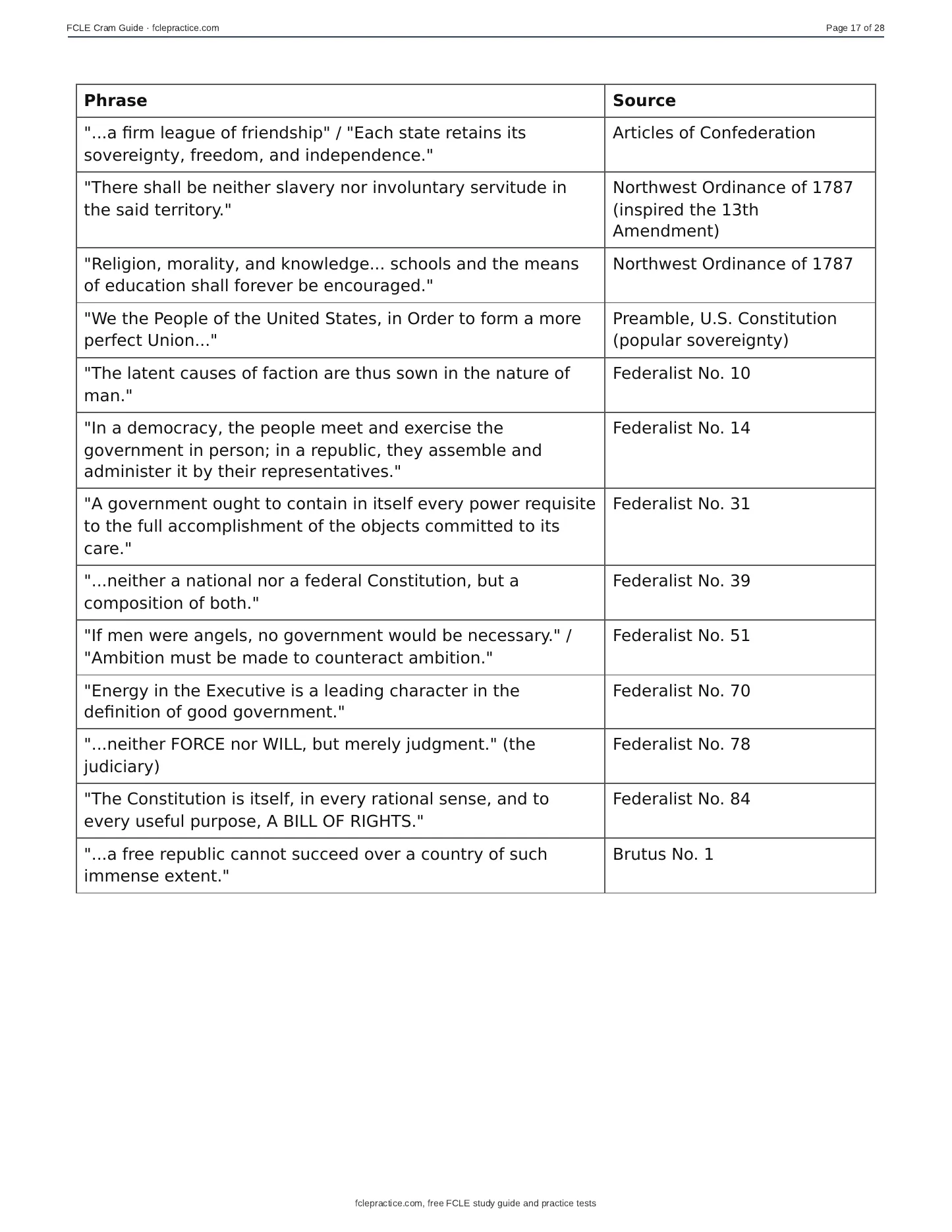
"...a firm league of friendship" / "Each state retains its
sovereignty, freedom, and independence."
Articles of Confederation
"There shall be neither slavery nor involuntary servitude in
the said territory."
Northwest Ordinance of 1787
(inspired the 13th
Amendment)
"Religion, morality, and knowledge... schools and the means
of education shall forever be encouraged."
Northwest Ordinance of 1787
"We the People of the United States, in Order to form a more
perfect Union..."
Preamble, U.S. Constitution
(popular sovereignty)
"The latent causes of faction are thus sown in the nature of
man."
Federalist No. 10
"In a democracy, the people meet and exercise the
government in person; in a republic, they assemble and
administer it by their representatives."
Federalist No. 14
fclepractice.com, free FCLE study guide and practice tests
Page 11: Phrase
Source
"A government ought to contain in itself every power requisite
to the full accomplishment of the objects committed to its
care."
Federalist No. 31
"...neither a national nor a federal Constitution, but a
composition of both."
Federalist No. 39
"If men were angels, no government would be necessary." /
"Ambition must be made to counteract ambition."
Federalist No. 51
"Energy in the Executive is a leading character in the
definition of good government."
Federalist No. 70
"...neither FORCE nor WILL, but merely judgment." (the
judiciary)
Federalist No. 78
"The Constitution is itself, in every rational sense, and to
every useful purpose, A BILL OF RIGHTS."
Federalist No. 84
"...a free republic cannot succeed over a country of such
immense extent."
Brutus No. 1
fclepractice.com, free FCLE study guide and practice tests
Page 12: Competency 4: Cases, laws, executive actions
Trap pairs
Trap pair
How to tell them apart
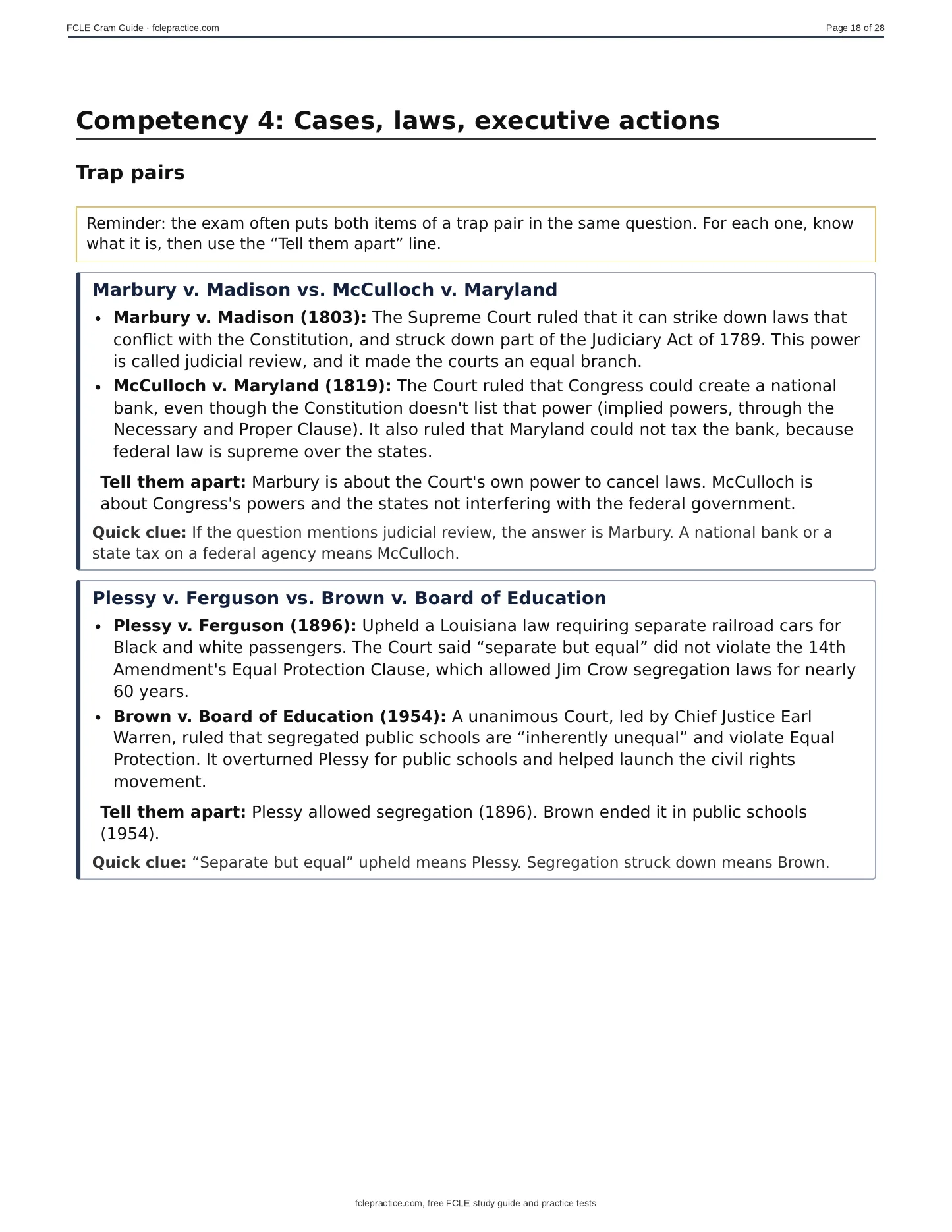
Marbury vs. McCulloch
Marbury: judicial review. McCulloch: implied powers plus
federal supremacy over state taxes.
Plessy vs. Brown
Plessy allowed separate but equal; Brown overturned it
for schools.
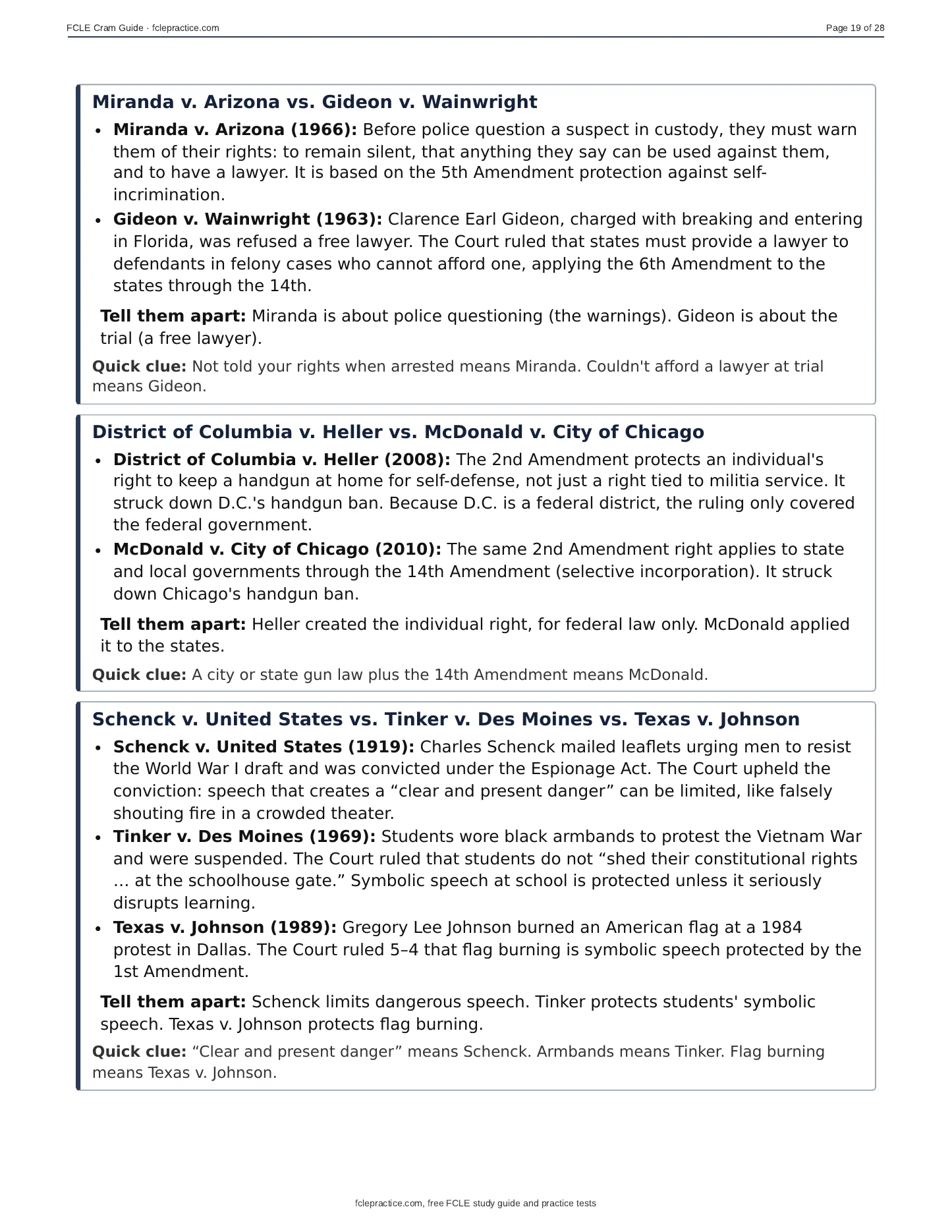
Miranda vs. Gideon
Miranda: police must warn you of your rights. Gideon:
the state must give you a lawyer at trial.
Heller vs. McDonald
Heller: individual gun right (D.C., federal). McDonald:
same right applies to the states.
Schenck vs. Tinker vs. Texas v.
Johnson
Speech can be limited when dangerous; students keep
symbolic speech; flag burning is protected.
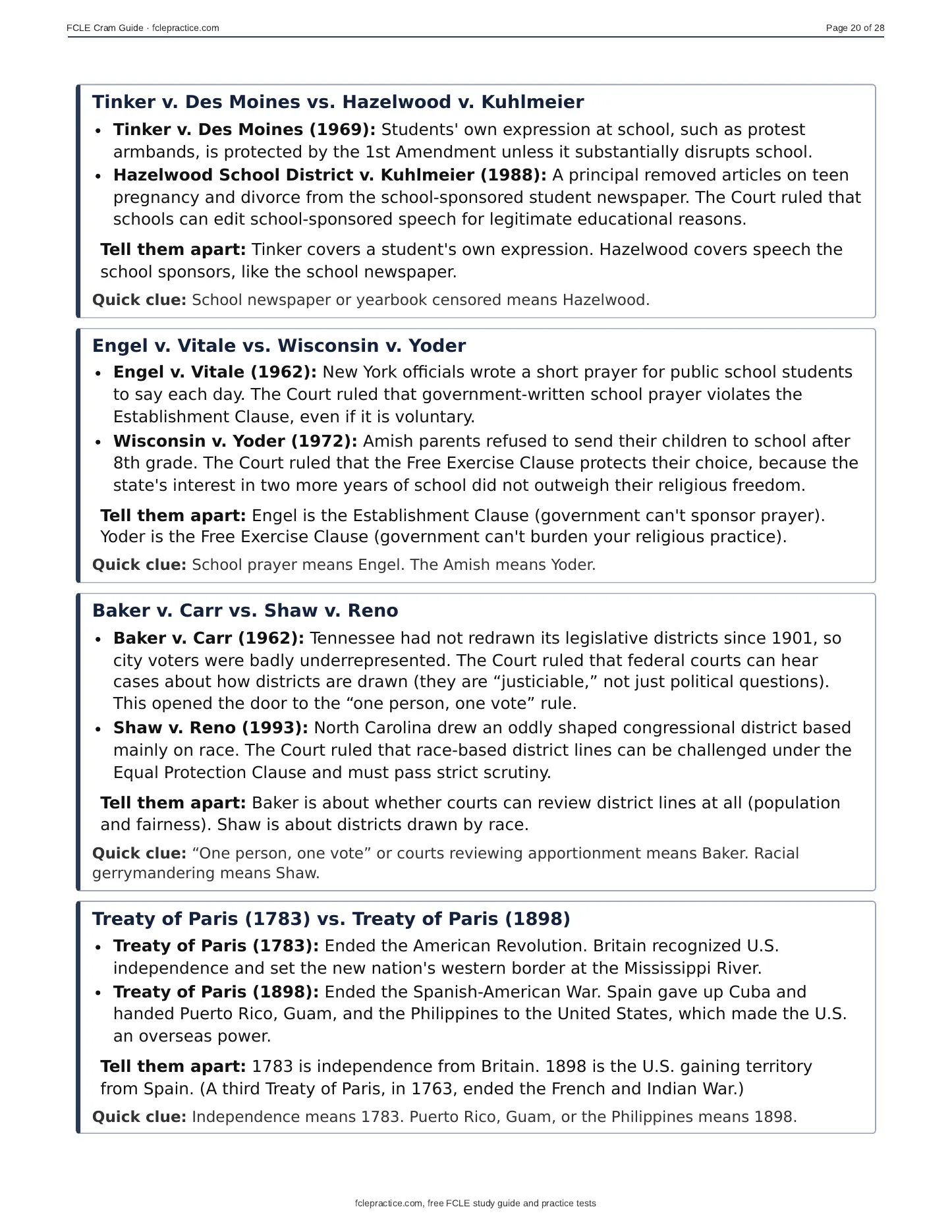
Tinker vs. Hazelwood
Students' own expression is protected; schoolsponsored papers can be edited.
Engel vs. Yoder
Establishment Clause (no school prayer) vs. Free
Exercise Clause (Amish schooling).
Baker v. Carr vs. Shaw v. Reno
Courts can review apportionment vs. race-based district
lines face strict scrutiny.
Treaty of Paris 1783 vs. 1898
1783 ended the Revolution; 1898 ended the SpanishAmerican War.
Missouri Compromise vs.
Compromise of 1850 vs. KansasNebraska
36°30′ line (1820) vs. California free plus Fugitive Slave
Act (1850) vs. popular sovereignty that erased the 1820
line (1854).
Civil Rights Act 1964 vs. Voting
Rights Act 1965
Discrimination in public places and jobs vs. barriers to
voting such as literacy tests.
Gulf of Tonkin vs. War Powers
Resolution
1964 expanded the president's war power; 1973 limited
it.
All 26 landmark cases
Case
Year Holding
About
Marbury v.
Madison
1803 Created judicial review: the Court can
strike down a law that conflicts with
the Constitution.
Judicial review, Article III,
checks and balances
fclepractice.com, free FCLE study guide and practice tests
Page 13: Case
Year Holding
About
McCulloch v.
Maryland
1819 Congress could create a national bank
(implied power); a state (Maryland)
cannot tax it.
Necessary and Proper
Clause, Supremacy Clause
Dred Scott v.
Sandford
1857 Black Americans were not citizens;
Congress could not ban slavery in
territories (Missouri Compromise struck
down).
Citizenship; restricted
rights; later reversed by
13th and 14th Amendments
Plessy v.
Ferguson
1896 Upheld state segregation laws under
"separate but equal."
Equal Protection (14th),
restricted rights
Schenck v. U.S.
1919 Anti-draft leaflets in WWI not
1st Amendment speech
protected; speech creating a "clear and limits
present danger" can be limited.
Korematsu v.
U.S.
1944 Upheld Japanese American internment
(Executive Order 9066) for national
security.
Equal protection, civil
liberties vs. national
security
Brown v. Board
of Education
1954 Racial segregation in public schools is
unconstitutional; overturned Plessy.
Equal Protection Clause
(14th)
Mapp v. Ohio
1961 Illegally obtained evidence cannot be
used in state courts (exclusionary
rule).
4th Amendment,
incorporated through the
14th
Baker v. Carr
1962 Federal courts can hear challenges to
how states draw legislative districts;
led to "one person, one vote."
Equal Protection,
apportionment
Engel v. Vitale
1962 Government-led prayer in public
schools is unconstitutional, even if
voluntary.
1st Amendment
Establishment Clause
Gideon v.
Wainwright
1963 States must provide a lawyer to felony
defendants who cannot afford one.
6th Amendment right to
counsel, incorporated
Miranda v.
Arizona
1966 Police must tell suspects in custody
their rights (silence, lawyer) before
questioning.
5th Amendment selfincrimination, 6th counsel
Tinker v. Des
Moines
1969 Students' black armbands protesting
Vietnam are protected symbolic
speech unless disruptive.
1st Amendment student
speech
New York Times
v. U.S.
1971 Government could not block
publication of the Pentagon Papers (no
prior restraint).
1st Amendment freedom of
the press
Wisconsin v.
Yoder
1972 Amish families cannot be forced to
send children to school past 8th grade.
1st Amendment Free
Exercise Clause
fclepractice.com, free FCLE study guide and practice tests
Page 14: Case
Year Holding
About
Roe v. Wade
1973 Right to privacy covered abortion;
overturned in 2022 by Dobbs v.
Jackson.
14th Amendment due
process, privacy
U.S. v. Nixon
1974 Executive privilege is not absolute;
Nixon had to hand over the Watergate
tapes.
Rule of law, checks and
balances
Regents of Univ.
of California v.
Bakke
1978 Racial quotas in admissions are
unconstitutional, but race could be one
factor.
Equal Protection,
affirmative action
Hazelwood v.
Kuhlmeier
1988 Schools may edit school-sponsored
student newspapers for legitimate
teaching reasons.
1st Amendment student
press, limited
Texas v. Johnson
1989 Burning the U.S. flag in protest is
protected symbolic speech.
1st Amendment symbolic
speech
Shaw v. Reno
1993 Districts drawn mainly by race face
strict scrutiny (racial gerrymandering).
Equal Protection,
redistricting
U.S. v. Lopez
1995 Gun-Free School Zones Act went
beyond Congress's commerce power.
Commerce Clause limits,
federalism
Bush v. Gore
2000 Stopped the Florida presidential
recount because counting standards
were inconsistent.
Equal Protection, elections
District of
Columbia v.
Heller
2008 The 2nd Amendment protects an
individual right to keep a handgun at
home for self-defense (federal district).
2nd Amendment, individual
right
McDonald v.
Chicago
2010 The 2nd Amendment applies to state
and local governments too.
2nd Amendment
incorporated through the
14th
Citizens United
v. FEC
2010 Government cannot limit independent
political spending by corporations and
unions.
1st Amendment political
speech
Landmark legislation
Law
Year
President /
Congress
What it did
Alien and Sedition
Acts
1798
John Adams,
Federalist
Congress
Allowed deporting immigrants and
punished criticism of the government;
restricted speech and press.
Missouri
Compromise
1820
James Monroe
Missouri slave state, Maine free; banned
slavery north of 36°30′ in the Louisiana
Territory.
fclepractice.com, free FCLE study guide and practice tests
Page 15: Law
Year
President /
Congress
What it did
Compromise of
1850
1850
Millard Fillmore;
Henry Clay
California free; popular sovereignty in Utah
and New Mexico; tougher Fugitive Slave
Act; ended slave trade in D.C.
Kansas-Nebraska
Act
1854
Franklin Pierce;
Stephen Douglas
Popular sovereignty in Kansas and
Nebraska; repealed the Missouri
Compromise line; led to "Bleeding Kansas."
Homestead Act
1862
Abraham Lincoln
160 acres of public land to settlers who
lived on and farmed it for 5 years; spurred
westward expansion.
Civil Rights Act of
1866
1866
Congress over
Andrew Johnson's
veto
Declared people born in the U.S. citizens
with equal rights to contract and own
property.
Pendleton Civil
Service Act
1883
Chester Arthur
Federal jobs filled by merit exams, not the
spoils system; passed after Garfield's
assassination.
Interstate
Commerce Act
1887
Grover Cleveland
First federal regulation of railroads; created
the Interstate Commerce Commission.
Sherman Antitrust
Act
1890
Benjamin Harrison Outlawed monopolies and trusts that
restrain trade.
New Deal acts (e.g.,
Social Security Act)
1933–
1938
Franklin D.
Roosevelt
Relief, recovery, reform; Social Security
(1935) created old-age pensions and
unemployment insurance.
Civil Rights Act of
1964
1964
Lyndon B. Johnson
Banned discrimination by race, color,
religion, sex, or national origin in public
places and jobs.
Gulf of Tonkin
Resolution
1964
Lyndon B. Johnson
Let the president use military force in
Vietnam without a declaration of war.
Voting Rights Act
1965
Lyndon B. Johnson
Banned literacy tests; federal oversight of
voting where discrimination occurred.
Great Society acts
(Medicare,
Medicaid)
1964–
1965
Lyndon B. Johnson
War on Poverty; health insurance for the
elderly (Medicare) and the poor (Medicaid);
federal school aid.
Civil Rights Act of
1968 (Fair Housing)
1968
Lyndon B. Johnson
Banned discrimination in the sale or rental
of housing.
Clean Air Act
1970
Richard Nixon
Federal air-quality standards and emission
limits.
Occupational Safety
and Health Act
1970
Richard Nixon
Federal workplace safety standards
(OSHA).
fclepractice.com, free FCLE study guide and practice tests
Page 16: Law
Year
President /
Congress
What it did
Title IX
1972
Richard Nixon
No sex discrimination in federally funded
education programs, including school
sports.
War Powers
Resolution
1973
Congress over
Nixon's veto
President must notify Congress within 48
hours and withdraw troops in 60 days
without approval.
Americans with
Disabilities Act
1990
George H. W.
Bush
Banned discrimination against people with
disabilities.
USA PATRIOT Act
2001
George W. Bush
Expanded government surveillance after
9/11; criticized for limiting civil liberties.
Affordable Care Act
2010
Barack Obama
Expanded health coverage: marketplaces,
Medicaid expansion, pre-existing condition
protections.
Landmark executive actions
Action
Year
President
What it did
Treaty of Paris
1783
Confederation
Congress
Ended the Revolutionary War; Britain
recognized U.S. independence.
Louisiana Purchase
1803
Thomas Jefferson
Bought from France; roughly
doubled the size of the U.S.
Adams-Onís Treaty
1819 (in
effect
1821)
James Monroe (Sec. of
State John Quincy
Adams)
Spain ceded Florida to the U.S. and
set a western border.
Monroe Doctrine
1823
James Monroe
Warned Europe against new
colonization in the Western
Hemisphere.
Suspension of
habeas corpus
1861
Abraham Lincoln
Allowed holding suspected
Confederate sympathizers without a
court hearing during the Civil War.
Emancipation
Proclamation
1863
Abraham Lincoln
Freed enslaved people in
Confederate-held areas.
Treaty of Paris
1898
William McKinley
Ended the Spanish-American War;
Spain ceded Puerto Rico, Guam, and
the Philippines.
Bully pulpit /
Square Deal
1901–
1909
Theodore Roosevelt
Used the presidency's visibility to
push reforms; Roosevelt coined
"bully pulpit."
fclepractice.com, free FCLE study guide and practice tests
Page 17: Action
Year
President
What it did
Fireside chats
1933–
1944
Franklin D. Roosevelt
Radio talks to build public support
for New Deal and wartime policies.
Executive Order
9066
1942
Franklin D. Roosevelt
Japanese American internment
(upheld in Korematsu).
Executive Order
9981
1948
Harry Truman
Desegregated the armed forces.
101st Airborne to
Little Rock
1957
Dwight Eisenhower
Federal troops enforced Brown v.
Board at Central High School.
Executive Orders
10925 and 11246
1961,
1965
John F. Kennedy;
Lyndon B. Johnson
"Affirmative action" in hiring by
federal contractors.
fclepractice.com, free FCLE study guide and practice tests
Page 18: Test-day tips
1. Read the question before the excerpt. Excerpt items ask one of three things: which
document or case it is from, which principle it shows, or what it inspired. Know what you
are hunting for, then read the passage.
2. Look for anchor words. "Faction" means Federalist 10, "ambition" or "angels" means 51,
"consent of the governed" means the Declaration, "government of laws and not of men"
means the Massachusetts Constitution.
3. Eliminate, then choose. Cross out options from the wrong era or branch first; two
choices usually fall away fast.
4. Scenario questions: name the right first. Police search on a street means the 4th
Amendment; denied a lawyer means Gideon; state vs. federal law means the Supremacy
Clause.
5. Pace yourself. Aim for about a minute per question so you finish all 80 with time to review
flagged items.
6. Never leave a blank. 48 of 80 passes, so answer every question; guess after eliminating.
fclepractice.com, free FCLE study guide and practice tests
Page 19: Must-know on Friday morning
1. 80 questions, about 20 per competency; 48 correct (60%) passes.
2. Locke: natural rights and consent of the governed. Montesquieu: separation of powers.
3. Rome was a republic; Athens was a direct democracy; the U.S. is a constitutional republic.
4. The referendum is the modern practice most like Athenian democracy.
5. Rule of law: no one, even the president, is above the law.
6. Articles I, II, III: Congress, president, courts. IV states, V amendments, VI supremacy, VII
ratification.
7. Amend: 2/3 of Congress proposes, 3/4 of states ratify.
8. Supremacy Clause settles state vs. federal conflicts; the 10th reserves leftover powers to
states.
9. Necessary and Proper Clause gives implied powers (McCulloch).
10. Selective incorporation applies the Bill of Rights to states through the 14th Amendment.
11. 1st speech and religion, 2nd arms, 4th searches, 5th self-incrimination and due process,
6th lawyer, 8th cruel and unusual.
12. 13th ended slavery, 14th citizenship and equal protection, 15th race and voting, 19th
women, 26th age 18.
13. House impeaches; Senate removes with 2/3.
14. Declaration: Jefferson, 1776. Constitution: Madison, 1787. Bill of Rights: 1791.
15. Massachusetts Constitution (1780, John Adams): "a government of laws and not of men."
16. Articles of Confederation: too weak; no power to tax.
17. Northwest Ordinance 1787 banned slavery in the territory and inspired the 13th.
18. Mayflower Compact: self-government; precedent for the Constitution.
19. Federalist 10 factions, 51 checks and balances (Madison); 78 judiciary, 84 no bill of rights
needed (Hamilton).
20. Brutus No. 1: Anti-Federalist; a big republic will crush the states.
21. Marbury: judicial review. Brown: overturned Plessy. U.S. v. Nixon: no one above the law.
22. Gideon: lawyer provided. Miranda: rights read. Mapp: illegal evidence excluded.
23. Korematsu: civil liberties lost to national security (EO 9066).
24. Truman's EO 9981 desegregated the military; Eisenhower sent troops to Little Rock.
25. Gulf of Tonkin 1964 widened war powers; War Powers Resolution 1973 limited them.
fclepractice.com, free FCLE study guide and practice tests
Page 20: Sources
FLDOE Supplemental Guide for the FCLE (Mar 31, 2022)
FLDOE FCLE Sample Items (Apr 6, 2022)
Your 1,000-question practice bank (PDF and spreadsheet)
fclepractice.com, free FCLE study guide and practice tests
Want more? Work through the learning path, read the study guide, or take a realistic exam.